Ever worry about losing access to your Bitcoin, or having it stolen with just one compromised password? Multi-signature (multi-sig) wallets offer a powerful solution. They’re not just a security upgrade; they fundamentally change
-how* you control your crypto. Think of it like needing multiple keys to open a safe – it adds a serious layer of protection that standard wallets simply can’t match.
Originally designed to address concerns around single points of failure in the early Bitcoin days, multi-sig has evolved into a crucial tool for everything from securing large corporate holdings to managing funds in decentralized organizations. It’s a bit more complex than a typical wallet, but the added security and flexibility are well worth understanding. Let’s dive into how it all works.

Understanding Multi-Signature Bitcoin Wallets
In the world of cryptocurrency, security is paramount. While Bitcoin is inherently secure thanks to its blockchain technology, the security of your access to those Bitcoins relies heavily on how you manage your private keys. For many years, the standard approach involved a single private key controlling a wallet. However, this creates a single point of failure.
Lose that key, and you lose your Bitcoin. Multi-signature (multi-sig) wallets offer a significant upgrade to this model, distributing control and dramatically increasing security. This article will dive deep into how they work, their benefits, and when you should consider using one.
Think of a traditional Bitcoin wallet like a bank account with only one signature required for withdrawals. A multi-sig wallet is more like an account requiring multiple signatures – perhaps two out of three authorized individuals – to approve a transaction. This simple change has profound implications for security and usability.
Introduction to Multi-Signature Wallets
A multi-signature wallet isn’t a fundamentally different type of Bitcoin wallet; it’s an enhancement to the way transactions are authorized. Instead of relying on a single private key to unlock and spend Bitcoin, it requires multiple keys. The core difference from single-signature wallets is this distributed control. With a single-sig wallet, one key compromise means complete loss of funds.
With a multi-sig wallet, a single key compromise doesn’t automatically lead to disaster.
Multi-sig wallets arose from a need to address the inherent risks of single-key management. Early Bitcoin adopters quickly realized that securing a single private key was a huge responsibility. Loss, theft, or compromise could be catastrophic. Multi-sig offered a solution, particularly for businesses and groups managing significant Bitcoin holdings. It wasn’t just about preventing theft; it was about preventing accidental loss or disputes within an organization.
Imagine a scenario: a small business uses a single-signature wallet to hold its Bitcoin reserves. The owner’s computer is hacked, and the private key is stolen. All the Bitcoin is gone. Now, imagine the same business using a 2-of-3 multi-sig wallet. The keys are held by the owner, the CFO, and a trusted security consultant.
Even if the owner’s computer is hacked, the attacker still needs access to at least one of the other two keys to move the funds. This drastically reduces the risk of loss.
| Wallet Type | Security Level | Convenience | Common Use Case |
|---|---|---|---|
| Single-Signature | Low | High | Personal use, small amounts |
| 2-of-3 Multi-Sig | Medium-High | Medium | Small business, joint accounts, escrow |
| 3-of-5 Multi-Sig | High | Low | Corporate treasuries, DAOs, high-value storage |
The Mechanics of Multi-Signature Transactions
Source: amazonaws.com
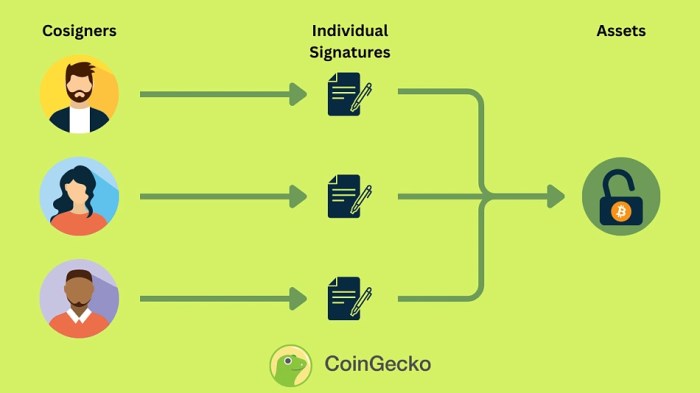
Creating a multi-signature transaction is more complex than a standard transaction, but the underlying principles remain the same. It begins with the initiation of a transaction, just like any other Bitcoin transfer. However, instead of a single signature being required, the transaction is constructed in a way that requires multiple signatures to become valid. This is achieved through a special type of Bitcoin script embedded within the transaction.
When a multi-sig transaction is initiated, it doesn’t immediately include any signatures. Instead, it’s a partially signed transaction (PSBT). Each key holder then uses their private key to sign the PSBT. The Bitcoin network doesn’t recognize the transaction as valid until enough signatures – as defined by the ‘m-of-n’ scheme – are included. The Bitcoin protocol handles multi-signature addresses and scripts by interpreting these scripts as requiring a specific number of valid signatures before funds can be spent.
The script essentially defines the conditions for spending the Bitcoin.
Here’s a step-by-step guide to setting up a 2-of-3 multi-sig wallet:
- Key Generation: Each of the three participants independently generates a Bitcoin private key pair (public and private key). This should be done using a secure method, ideally with a hardware wallet.
- Public Key Exchange: Each participant securely shares their public key with the other two. Never share your private key!
- Address Creation: Using all three public keys, a multi-sig address is created. This address is unique to this specific 2-of-3 setup.
- Funding the Wallet: Bitcoin is sent to the newly created multi-sig address.
- Transaction Signing: When a transaction needs to be made, two of the three key holders must sign it using their private keys.
- Transaction Broadcasting: Once two signatures are collected, the complete transaction is broadcast to the Bitcoin network.
Key Concepts: Thresholds and Quorums
Source: c-sharpcorner.com
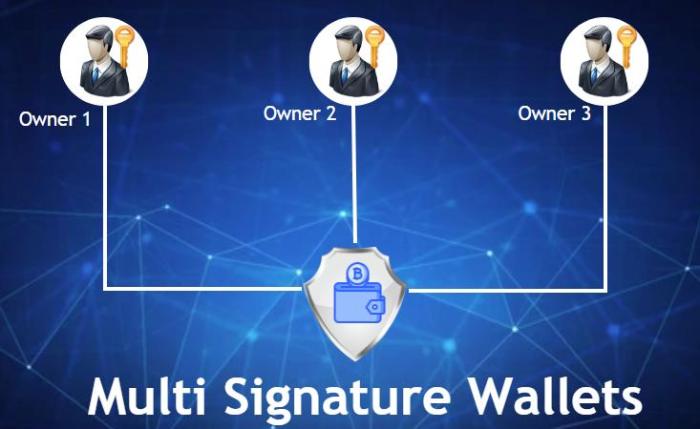
At the heart of multi-sig wallets lies the concept of ‘m-of-n’ multi-signature schemes. ‘n’ represents the total number of keys required to control the wallet, while ‘m’ represents the minimum number of keys needed to authorize a transaction. For example, in a 2-of-3 scheme, n=3 (three keys total) and m=2 (two signatures required). This ‘m’ value defines the threshold – the minimum requirement for a valid transaction.
Different threshold values significantly impact both security and usability. A higher threshold (e.g., 3-of-5) provides greater security because more key compromises are needed to steal funds. However, it also reduces convenience, as coordinating three or more signatures can be more challenging. Conversely, a lower threshold (e.g., 2-of-3) is more convenient but offers slightly less security.
There’s a trade-off. Increasing the threshold increases security but decreases usability. Decreasing the threshold increases usability but decreases security. The optimal threshold depends on the specific use case and the level of risk tolerance.
- Escrow Services (2-of-3): The buyer, seller, and escrow agent each hold a key. Funds are released when two signatures are provided – typically the seller and the escrow agent.
- Corporate Treasuries (3-of-5): Key holders could include the CEO, CFO, and three board members. This prevents a single individual from unilaterally accessing the funds.
- Joint Accounts (2-of-2): Both account holders must approve any transaction.
- DAO Governance (4-of-7): A decentralized autonomous organization might use a 4-of-7 scheme to require a majority vote for significant financial decisions.
Security Advantages of Multi-Sig Wallets
Multi-sig wallets fundamentally mitigate the risks associated with single points of failure. In a single-sig wallet, a compromised private key means complete loss of control. In a multi-sig wallet, a single key compromise doesn’t automatically grant access to the funds. This is a crucial difference.
Multi-sig wallets protect against both internal and external threats. Internally, they prevent rogue employees from stealing funds without collusion. Externally, they make it significantly harder for hackers to steal funds, even if they compromise one of the keys. They also protect against accidental loss of a single key; as long as enough other keys remain secure, the funds are still accessible.
Several real-world security breaches could have been prevented with multi-sig wallets. For example, if Mt. Gox had used a multi-sig setup, the loss of the private keys wouldn’t have resulted in the theft of hundreds of thousands of Bitcoins. Similarly, many exchange hacks could have been mitigated by storing funds in multi-sig wallets with keys distributed among multiple trusted parties.
Imagine a diagram: Three key holders (Alice, Bob, and Carol) each possess a private key. A transaction request originates from Alice. The request is sent to Bob and Carol, who must independently sign it using their private keys. Only when two signatures are combined is the transaction valid and broadcast to the Bitcoin network. Security layers are represented by firewalls around each key holder’s device and encryption protecting the private keys themselves.
The transaction flow is clearly depicted, showing the need for multiple approvals before funds can be moved.
Use Cases for Multi-Signature Wallets
The applications of multi-sig wallets extend far beyond simply securing individual Bitcoin holdings. Escrow services are a prime example. A multi-sig wallet can hold funds in escrow until certain conditions are met, with the buyer, seller, and escrow agent each holding a key.
Businesses can leverage multi-sig wallets for managing corporate Bitcoin holdings, ensuring that no single employee can unilaterally access the funds. This provides a layer of internal control and accountability. It also simplifies auditing and reduces the risk of fraud.
Decentralized autonomous organizations (DAOs) increasingly rely on multi-sig wallets for governance and fund management. Key holders can be elected members of the DAO, and transactions require a quorum of signatures to be approved, ensuring that decisions are made collectively and transparently.
| Use Case | Recommended Configuration | Benefits |
|---|---|---|
| Escrow Service | 2-of-3 | Impartial fund release, reduced risk of fraud |
| Corporate Treasury | 3-of-5 | Enhanced internal control, protection against rogue employees |
| DAO Governance | 4-of-7 | Decentralized decision-making, transparent fund management |
| Joint Account | 2-of-2 | Shared control, mutual approval for transactions |
Setting Up and Using a Multi-Sig Wallet: A Practical Guide
Selecting a compatible Bitcoin wallet is the first step. Not all wallets support multi-signature functionality. Popular options include Electrum, Specter Desktop, and Casa. Ensure the wallet you choose is reputable and well-maintained.
Secure key generation and storage are critical. Each participant should generate their private key using a strong random number generator, ideally on a hardware wallet like a Ledger or Trezor. Hardware wallets provide an extra layer of security by storing the private key offline. Never store your private key on a computer or mobile device connected to the internet.
Once the keys are generated, the public keys must be securely exchanged. Use a secure communication channel, such as Signal or a face-to-face meeting. After exchanging public keys, the multi-sig address can be created within the chosen wallet software. This address should then be shared with all participants.
To maximize security, always back up your private keys in multiple secure locations. Consider using Shamir Secret Sharing (SSS) to split your key into multiple parts, requiring a threshold number of parts to reconstruct the original key. Regularly review and update your security practices to stay ahead of potential threats.
Advanced Multi-Sig Features and Considerations
“Timelocks” add an extra layer of security by delaying the ability to spend funds until a specific date or block height. This can be combined with multi-sig to create scenarios where funds can only be spent after a certain period if a specific condition isn’t met. For example, funds could be locked in a 2-of-3 multi-sig wallet with a timelock, requiring two signatures within 30 days or the funds are returned to the original sender.
“Revocable multi-sig” schemes allow for the revocation of a key holder’s access to the wallet. This is a more complex setup but can be useful in situations where trust relationships change. However, revocability introduces its own complexities and potential vulnerabilities.
Key management in multi-sig wallets presents challenges. Key loss is a significant concern, as losing enough keys can result in permanent loss of funds. Coordination among participants can also be difficult, especially in geographically dispersed teams. Hardware wallet integration helps mitigate key loss but doesn’t eliminate the coordination challenge.
Multi-Sig vs. Other Security Measures
Source: framerusercontent.com
Multi-sig wallets aren’t a replacement for other security measures; they’re a complement to them. Hardware wallets provide secure storage of private keys, while two-factor authentication adds an extra layer of protection to your wallet access. Multi-sig builds on these foundations by distributing control and reducing the risk of a single point of failure.
Multi-sig wallets and hardware wallets work synergistically. Using a hardware wallet to generate and store the private keys used in a multi-sig setup provides the highest level of security. Two-factor authentication can be used to protect access to the wallet software itself.
Multi-sig wallets aren’t always the most appropriate solution. For small amounts of Bitcoin, the added complexity may not be justified. If you’re the sole user and are confident in your ability to secure your private key, a single-sig wallet with a hardware wallet may be sufficient.
- Essential: Managing significant Bitcoin holdings (corporate treasuries, DAOs).
- Recommended: Joint accounts, escrow services, situations where multiple parties need to control funds.
- Unnecessary: Small amounts of Bitcoin, personal use where the user is confident in their security practices.
Ultimate Conclusion
So, there you have it – a deep dive into the world of multi-sig Bitcoin wallets. They’re a game-changer for anyone serious about securing their digital assets, offering a level of control and protection that single-signature wallets can’t provide. While there’s a learning curve, the benefits – mitigating risk, enabling collaborative control, and bolstering overall security – are substantial.
Ultimately, multi-sig isn’t just about
-if* something goes wrong, but
-how* you’re prepared when it does. It’s a proactive approach to security in a space where taking responsibility for your own funds is paramount. Exploring the different threshold options and use cases will help you determine if a multi-sig wallet is the right fit for your needs, and empower you to take control of your Bitcoin future.
Question & Answer Hub
What happens if I lose one of the keys in a multi-sig wallet?
It depends on the ‘m-of-n’ configuration. If you have a 2-of-3 setup, you can still access your funds with the other two keys. Losing a single key doesn’t mean losing access, but losing enough keys to fall below the threshold
-will* result in lost funds.
Are multi-sig transactions more expensive than single-sig transactions?
Generally, yes. Multi-sig transactions are larger in size due to the added script complexity, which means higher transaction fees. However, the increased security often outweighs the cost.
Can I use a hardware wallet with a multi-sig setup?
Absolutely! In fact, it’s
-highly* recommended. Using hardware wallets for each key adds a significant layer of security, as your private keys are stored offline and protected from online threats.
Is multi-sig only for large Bitcoin holders?
Not at all! While it’s popular with businesses and high-net-worth individuals, multi-sig can benefit anyone who wants to enhance their security, even with smaller amounts of Bitcoin. It’s especially useful for joint accounts or situations where you want shared control.
What is a timelock and how does it work with multi-sig?
A timelock adds a condition to a multi-sig transaction that it can only be executed after a specific date or block height. This can be used to ensure funds are only released if certain conditions are met within a defined timeframe, adding another layer of security and trust.
