For centuries, gold has been
-the* go-to safe haven, a symbol of wealth and stability. But in the last decade, Bitcoin has emerged as a challenger, promising a digital alternative to traditional stores of value. It’s a fascinating showdown, really – the ancient versus the modern, the physical versus the digital. We’re all trying to figure out where to put our money, especially when things feel uncertain, and understanding the strengths and weaknesses of both gold and Bitcoin is more important than ever.
This isn’t just about picking a winner. It’s about understanding how these assets function, how they’ve performed, and what the future might hold. We’ll dive into everything from historical price swings and security concerns to regulatory hurdles and practical considerations like actually
-moving* your wealth around. Let’s unpack this and see which one truly shines as a long-term store of value.
Bitcoin vs. Gold: A Timeless Debate on Value
For centuries, gold has been the go-to store of value, a symbol of wealth and security. But in the 21st century, a new contender has emerged: Bitcoin. This digital asset promises many of the same benefits as gold – scarcity, portability, and a hedge against economic uncertainty – but in a fundamentally different form. This article dives deep into a comparison of these two assets, examining their historical performance, practical considerations, and future potential.
It’s not about declaring a winner, but about understanding the nuances of each and how they might fit into a diversified portfolio.
Historical Performance & Scarcity
Understanding the past performance of both gold and Bitcoin is crucial to assessing their viability as stores of value. Gold’s history is long and well-documented, while Bitcoin’s is relatively short but incredibly dynamic. Scarcity is a key component of value, and both assets possess it, albeit in different ways.
Gold’s price has fluctuated significantly over the last 50 years. In the 1970s, it surged from around $35/ounce to over $500/ounce, driven by inflation and the collapse of the Bretton Woods system. The 1980s and 90s saw a decline as interest rates rose, but gold experienced another rally in the early 2000s, fueled by geopolitical instability and a weakening dollar.
The 2008 financial crisis triggered a massive influx of investment into gold, pushing prices to record highs. More recently, gold has seen periods of consolidation and growth, influenced by factors like central bank policies and global economic conditions.
Estimates suggest around 209,000 tonnes of gold have been mined to date. While significant reserves remain, particularly in countries like Australia, Russia, and the United States, discovering new, economically viable gold deposits is becoming increasingly challenging and expensive. The cost of extraction continues to rise, impacting future supply.
Bitcoin, created in 2009, operates on a fundamentally different scarcity model. Its mining process, which involves solving complex computational problems, is designed to release new Bitcoins at a decreasing rate. This process is governed by the protocol and will continue until the total supply reaches a hard cap of 21 million coins. This programmed scarcity is a core tenet of Bitcoin’s value proposition, differentiating it from traditional assets like gold, where supply can be influenced by mining discoveries and production costs.
Here’s a comparison of the annual percentage change in price for both Bitcoin and Gold over the last 10 years:
| Year | Gold % Change | Bitcoin % Change | Notable Event |
|---|---|---|---|
| 2014 | -1.9% | 35.8% | Ukraine crisis, Ebola outbreak |
| 2015 | 7.9% | -3.6% | China economic slowdown |
| 2016 | 8.2% | 134.8% | Brexit vote, US Presidential Election |
| 2017 | 11.8% | 1318.0% | Cryptocurrency boom |
| 2018 | -1.6% | -73.8% | Cryptocurrency winter |
| 2019 | 18.4% | 87.3% | US-China trade war |
| 2020 | 24.7% | 305.7% | COVID-19 pandemic, economic stimulus |
| 2021 | -3.7% | 58.8% | Inflation concerns, institutional adoption |
| 2022 | -0.2% | -64.2% | Rising interest rates, FTX collapse |
| 2023 | 12.9% | 157.8% | Banking crisis, anticipation of rate cuts |
Divisibility & Portability
The practical aspects of owning and transferring wealth are critical considerations. Gold, while valuable, presents significant logistical challenges. Bitcoin, as a digital asset, offers a stark contrast in terms of divisibility and portability.
Physically storing and transporting large quantities of gold is a complex undertaking. It requires secure vaults, specialized transportation services, and robust insurance coverage. The costs associated with these measures can be substantial, and the risk of theft or loss is ever-present. Authenticating gold’s purity also requires assaying, adding another layer of complexity and expense. Moving gold internationally involves customs regulations, potential tariffs, and lengthy transit times.
Bitcoin, on the other hand, is inherently divisible and portable. A single Bitcoin can be divided into eight decimal places (Satoshis), allowing for transactions of any size. Its digital nature means it can be transferred across borders almost instantly and with relatively low fees (though fees can fluctuate). This ease of transfer makes Bitcoin particularly attractive for international transactions and remittances.
Fractional ownership of gold is achieved through instruments like Exchange-Traded Funds (ETFs) and gold shares. While these provide access to gold investment without the need for physical storage, they come with associated fees, such as management fees and brokerage commissions. These fees can erode returns over time, and investors don’t directly own the underlying gold. Bitcoin transactions, while subject to network fees, generally avoid the ongoing costs associated with gold ETFs.
Let’s consider a scenario: transferring $100,000 worth of each asset across international borders. For gold, this would likely involve purchasing gold bullion, arranging secure transportation (potentially through an armored carrier), navigating customs procedures, and insuring the shipment. This process could take several days or even weeks and incur costs ranging from thousands to tens of thousands of dollars. For Bitcoin, the process is far simpler.
The $100,000 worth of Bitcoin could be sent to an international wallet address within minutes, with a transaction fee typically ranging from a few dollars to a few hundred dollars, depending on network congestion. The primary challenge with Bitcoin would be ensuring the recipient has a secure wallet and understands how to access and safeguard their funds.
Regulatory Landscape & Acceptance
The regulatory environment surrounding both gold and Bitcoin significantly impacts their adoption and use. Gold has a long-established regulatory framework, while Bitcoin’s is still evolving and varies considerably across jurisdictions.
Gold has historically been treated as a safe haven asset by governments and central banks. Regulations typically focus on taxation of gains and reporting requirements for large transactions. In most major economies, gold is subject to sales tax and capital gains tax. Reporting requirements are often triggered when transactions exceed a certain threshold. The regulatory treatment of gold is generally consistent and well-defined.
The regulatory landscape surrounding Bitcoin is far more fragmented. Some countries have embraced Bitcoin, while others have imposed strict restrictions or outright bans. The United States, for example, treats Bitcoin as property for tax purposes, while the European Union is developing comprehensive regulations through the Markets in Crypto-Assets (MiCA) framework. China has banned all cryptocurrency transactions, while El Salvador has adopted Bitcoin as legal tender.
This regulatory uncertainty can hinder adoption and create challenges for businesses operating in the crypto space.
Institutional acceptance of gold is widespread. Central banks hold significant gold reserves as a store of value and a hedge against currency fluctuations. Major investors, such as pension funds and sovereign wealth funds, also allocate a portion of their portfolios to gold. Institutional acceptance of Bitcoin is growing, but it remains significantly lower than that of gold. While some institutional investors have begun to allocate capital to Bitcoin, many remain hesitant due to regulatory concerns and price volatility.
Here’s a list of countries with favorable and unfavorable regulations for Bitcoin:
- Favorable:
- El Salvador: Bitcoin is legal tender.
- Portugal: No capital gains tax on Bitcoin holdings for over a year.
- Switzerland: Crypto-friendly regulations and a growing crypto ecosystem.
- Unfavorable:
- China: Complete ban on cryptocurrency transactions.
- Nigeria: Restrictions on cryptocurrency transactions through banks.
- Egypt: Islamic religious authorities have declared Bitcoin haram (forbidden).
Security & Vulnerability
Source: rockitcoin.com
Security is paramount when considering a store of value. Both gold and Bitcoin face unique security challenges, requiring different mitigation strategies.
Securing physical gold involves a multi-layered approach. This includes storing gold in secure vaults, utilizing insurance policies to cover potential losses, and employing private security personnel to protect against theft. However, even with these measures, gold remains vulnerable to physical theft, counterfeiting, and geopolitical risks. The security of gold ultimately relies on the physical protection of the asset.
Bitcoin’s security is rooted in cryptography and blockchain technology. Blockchain is a distributed, immutable ledger that records all Bitcoin transactions. Hashing algorithms ensure the integrity of the data, and private keys are used to authorize transactions. This cryptographic foundation makes Bitcoin highly resistant to tampering and censorship. However, Bitcoin is not immune to security threats.
Potential security threats to Bitcoin include hacking of exchanges and wallets, 51% attacks (where a malicious actor gains control of the majority of the network’s hashing power), and phishing scams. Mitigation strategies include using hardware wallets to store private keys offline, enabling two-factor authentication, and being vigilant against phishing attempts. The security of Bitcoin ultimately relies on the strength of its cryptography and the integrity of the network.
Here’s a table outlining common security risks for both assets:
| Risk | Asset (Gold/Bitcoin) | Likelihood (High/Medium/Low) | Potential Impact |
|---|---|---|---|
| Theft | Gold | Medium | Total loss of asset |
| Counterfeiting | Gold | Medium | Loss of value, legal issues |
| Exchange Hack | Bitcoin | Medium | Loss of funds held on exchange |
| 51% Attack | Bitcoin | Low | Double-spending, network disruption |
| Phishing Scam | Bitcoin | High | Loss of private keys, loss of funds |
| Geopolitical Risk | Gold | Medium | Confiscation, price manipulation |
Transaction Costs & Speed
The costs and speed associated with transacting in gold and Bitcoin differ significantly. These factors impact the practicality of using each asset for everyday transactions.
Buying, selling, and storing gold involves various costs. Premiums are paid above the spot price when purchasing gold bullion. Assay fees are incurred when verifying the purity of gold. Storage costs, whether for safe deposit boxes or private vaults, add to the overall expense. These costs can significantly reduce returns, especially for smaller investments.
Bitcoin transaction fees are influenced by network congestion and transaction size. During periods of high demand, fees can spike, making small transactions impractical. However, fees have generally decreased over time as the network has scaled. The cost of a Bitcoin transaction can range from a few cents to several dollars, depending on network conditions.
Typical transaction settlement times for gold are relatively slow. Buying or selling gold bullion often requires several days for delivery and verification. International gold transfers can take even longer due to customs procedures and logistical challenges. Bitcoin transactions, on the other hand, typically settle within minutes, although confirmation times can vary depending on network congestion. This speed makes Bitcoin more suitable for time-sensitive transactions.
Layer-2 solutions, such as the Lightning Network, aim to address Bitcoin’s scalability and transaction speed limitations. The Lightning Network enables off-chain transactions, allowing users to send and receive Bitcoin almost instantly and with extremely low fees. This technology has the potential to make Bitcoin a viable option for everyday payments.
Use Cases Beyond Store of Value
While both gold and Bitcoin are primarily considered stores of value, they also have other applications. Gold has a long history of industrial use, while Bitcoin is unlocking new possibilities in the realm of decentralized finance.
Gold has numerous industrial applications. It’s used in electronics due to its excellent conductivity, in dentistry for fillings and crowns, and in jewelry for its aesthetic appeal. These industrial uses contribute to the overall demand for gold and provide a degree of price support. Gold also plays a role in certain medical treatments and aerospace applications.
Bitcoin is emerging as a foundational technology for decentralized finance (DeFi). DeFi applications, built on the Bitcoin blockchain (and increasingly on sidechains and layer-2 solutions), offer services like lending, borrowing, and trading without the need for intermediaries. Smart contracts, self-executing agreements written in code, enable automated and transparent transactions. Non-fungible tokens (NFTs), unique digital assets, are also gaining traction on the Bitcoin network, representing ownership of digital art, collectibles, and other assets.
Gold-backed tokens are a relatively new development, combining the benefits of gold and blockchain technology. These tokens represent ownership of physical gold stored in secure vaults. They offer the liquidity and portability of cryptocurrencies while being backed by a tangible asset. This integration of gold and blockchain could potentially increase the accessibility and efficiency of gold investment.
Consider this scenario: a complex supply chain transaction involving multiple parties and international shipments. Traditionally, this would involve numerous intermediaries, lengthy paperwork, and significant delays. However, using Bitcoin and smart contracts, the entire process could be automated. A smart contract could be programmed to release payment to the supplier once the goods have been verified and delivered, eliminating the need for trust and reducing the risk of fraud.
This illustrates the potential of Bitcoin to streamline complex transactions and improve efficiency.
“The beauty of Bitcoin is that it allows for trustless transactions, removing the need for intermediaries and reducing the risk of counterparty failure. This has the potential to revolutionize supply chain management and other industries.”
Market Liquidity & Accessibility
The liquidity and accessibility of an asset are crucial for investors. Gold boasts a highly liquid global market, while Bitcoin’s liquidity is growing rapidly but remains less established.
The global gold market is vast and well-established. It includes exchanges like the COMEX and the London Bullion Market Association (LBMA), bullion dealers, and central bank holdings. Gold is traded 24/7, and there’s a deep pool of buyers and sellers, ensuring high liquidity. Central banks play a significant role in the gold market, buying and selling gold to manage their reserves.
Bitcoin is traded on various exchanges and platforms, such as Coinbase, Binance, and Kraken. These exchanges offer different order types, including market orders, limit orders, and stop-loss orders. Trading strategies range from short-term speculation to long-term investment. While Bitcoin’s liquidity has increased significantly in recent years, it’s still less liquid than the gold market. Price volatility can also impact liquidity, especially during periods of market stress.
Accessibility to gold varies across the world. In developed countries, it’s relatively easy to purchase gold bullion or invest in gold ETFs. However, in some developing countries, access to gold investment may be limited. Bitcoin’s accessibility is largely dependent on internet access and financial inclusion. In countries with limited internet infrastructure or restrictive financial regulations, access to Bitcoin may be challenging.
However, the increasing availability of mobile wallets and peer-to-peer trading platforms is improving accessibility in many parts of the world.
Imagine a visual representation of the global distribution of Bitcoin ATMs and gold bullion dealers. A world map would show a dense concentration of Bitcoin ATMs in North America, Europe, and Australia, with fewer ATMs in Africa and South America. Gold bullion dealers would be more evenly distributed, with significant concentrations in major financial centers like London, New York, and Zurich.
This visual would highlight the differing levels of accessibility for each asset.
Inflation Hedge Characteristics
Source: lendedu.com
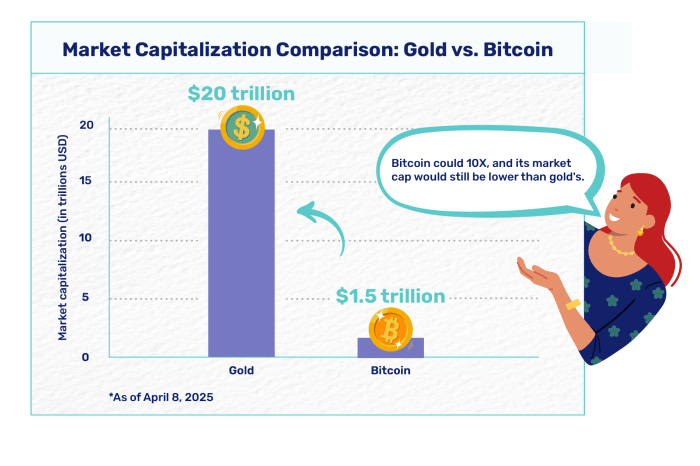
The ability to protect against inflation is a key consideration for any store of value. Gold has historically been viewed as an inflation hedge, but Bitcoin’s performance in this regard is still being evaluated.
Historically, gold has performed well during periods of high inflation. In the 1970s, when inflation soared, gold prices rose dramatically. However, gold’s performance as an inflation hedge has been inconsistent in recent decades. During periods of low inflation, gold prices have often stagnated or even declined. The relationship between gold and inflation is complex and influenced by factors like real interest rates and investor sentiment.
The arguments for Bitcoin being an effective inflation hedge center on its limited supply. The programmed scarcity of 21 million coins suggests that Bitcoin should retain its value during periods of currency debasement. However, Bitcoin’s limited history and volatile price movements make it difficult to assess its long-term effectiveness as an inflation hedge. Bitcoin’s price has often been driven by speculation and market sentiment, rather than fundamental economic factors.
“Real interest rates” – the nominal interest rate minus the inflation rate – play a significant role in the attractiveness of both gold and Bitcoin. When real interest rates are low or negative, investors tend to favor assets like gold and Bitcoin, which offer a store of value outside of traditional financial systems. When real interest rates are high, investors may prefer interest-bearing assets, reducing demand for gold and Bitcoin.
Here’s a list of economic indicators that typically influence the price of gold and Bitcoin, respectively:
- Gold:
- Inflation rate
- Real interest rates
- US dollar strength
- Geopolitical instability
- Central bank gold purchases
- Bitcoin:
- Inflation rate
- Regulatory developments
- Institutional adoption
- Network activity (transaction volume, hash rate)
- Market sentiment
Closure

Source: finxter.com
So, after looking at everything – the history, the practicality, the risks, and the potential – where does that leave us? The truth is, there’s no easy answer. Gold offers a long track record and widespread acceptance, but comes with storage and logistical headaches. Bitcoin, while newer and more volatile, boasts portability, divisibility, and a growing ecosystem.
Ultimately, the “better” store of value depends on your individual circumstances and risk tolerance. Perhaps a diversified approach, incorporating both gold
-and* Bitcoin, is the most sensible path. The conversation is evolving, and staying informed is key. Both assets present unique opportunities and challenges, and the future will likely see them coexisting, each appealing to different investors in a changing world.
Expert Answers
Is Bitcoin really scarce like gold?
Yes, Bitcoin has a hard cap of 21 million coins, meaning no more will ever be created. Gold’s scarcity is based on the amount remaining in the earth, which is still being discovered, though at a decreasing rate. Both are designed to resist inflation through limited supply.
What happens if I lose my Bitcoin “wallet”?
If you lose access to your private keys (the password to your Bitcoin wallet), your Bitcoin is effectively lost. Unlike gold, there’s no central authority to recover it for you. Securely backing up your keys is
-crucial*.
Is Bitcoin legal everywhere?
No. Bitcoin’s legal status varies significantly by country. Some countries have embraced it, others have restricted it, and some remain in a gray area. It’s important to check the regulations in your jurisdiction.
How does gold perform during economic recessions?
Historically, gold has often performed well during recessions as investors seek safe haven assets. However, performance isn’t guaranteed and can be influenced by other factors like interest rates and inflation.
Can I use Bitcoin for everyday purchases?
While adoption is growing, Bitcoin isn’t widely accepted for everyday purchases yet. However, some businesses do accept it, and services like Bitcoin debit cards allow you to spend Bitcoin at merchants that accept traditional credit cards.
