Understanding Market Cycles in the Cryptocurrency Space feels a bit like learning to read the seasons. Just as nature ebbs and flows, so too does the crypto market, moving through predictable phases of growth and decline. But unlike the natural world, these cycles are driven by a fascinating mix of human psychology, technological innovation, and global economics. It’s a wild ride, but one that becomes significantly less daunting – and potentially more profitable – when you understand the underlying patterns.
This isn’t just about charts and numbers, though those are important. It’s about recognizing the collective emotions of the market, anticipating shifts in sentiment, and positioning yourself strategically. We’ll dive into what makes crypto cycles unique, how to spot the turning points, and how to navigate them with a bit more confidence. Whether you’re a seasoned trader or just starting out, grasping these concepts is crucial for long-term success.



Understanding Market Cycles in the Cryptocurrency Space
The world of cryptocurrency often feels like a rollercoaster, with dramatic price swings and periods of intense volatility. But beneath the surface chaos, there’s a rhythm – a predictable pattern of expansion and contraction known as market cycles. Understanding these cycles isn’t about predicting the future with certainty, but about recognizing where we are in the current cycle and making more informed decisions.
It’s about moving
-with* the tide, rather than constantly fighting against it. This article will delve into the intricacies of market cycles, specifically as they apply to the crypto space, equipping you with the knowledge to navigate this dynamic landscape.
Market cycles aren’t unique to crypto. They’ve been observed in traditional financial markets for centuries, driven by fundamental economic forces and, crucially, human psychology. Recognizing these patterns, and how they manifest differently in the crypto world, is a powerful tool for any investor.
Introduction to Market Cycles
At its core, a market cycle represents the ebb and flow of investor sentiment and economic conditions. It’s a recurring pattern of growth (expansion) followed by decline (contraction). This isn’t random; it’s rooted in basic economic principles. When the economy is strong, businesses thrive, employment rises, and investors are optimistic, driving asset prices up. Eventually, this expansion leads to imbalances – overvaluation, excessive debt, or resource constraints – which trigger a correction, leading to a downturn.
This downturn, while painful, clears out excesses and sets the stage for the next cycle of growth.
Historically, we’ve seen these cycles play out in stocks (think of the dot-com bubble and subsequent crash), bonds (interest rate cycles impacting bond yields), and real estate (boom and bust cycles). The speed and intensity of these cycles vary. Real estate, for example, tends to have longer, more drawn-out cycles than the stock market. Cryptocurrency, as we’ll see, often exhibits cycles that are
-faster* and
-more volatile* than traditional markets.
The engine driving these cycles is human psychology. Fear and greed are the dominant forces. During a bull market (rising prices), greed takes over, leading investors to pile into assets, often ignoring warning signs. This creates a self-fulfilling prophecy, driving prices even higher. Conversely, during a bear market (falling prices), fear grips the market, causing panic selling and exacerbating the downturn.
Herd behavior – the tendency to follow the crowd – amplifies these psychological effects.
Unique Characteristics of Cryptocurrency Cycles
Source: cryptopotato.com
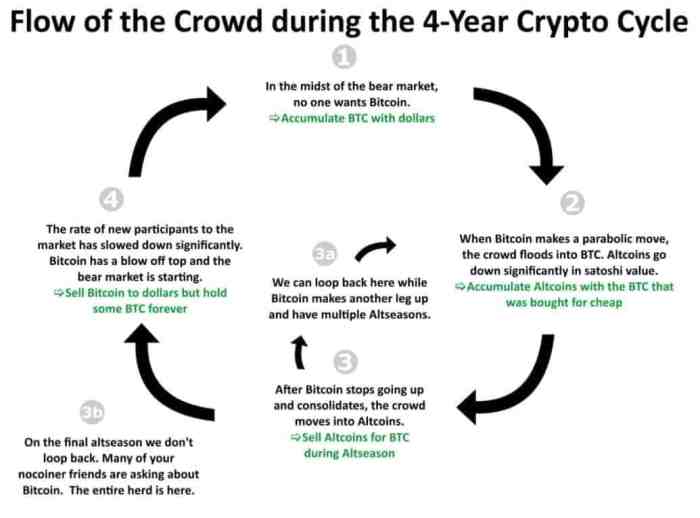
While the underlying principles of market cycles apply to crypto, the specifics are quite different. Crypto cycles tend to be more compressed in time – what might take years in the stock market can happen in months in crypto. This is due to several factors, including the 24/7 nature of crypto trading, the relatively small market capitalization compared to traditional assets, and the high degree of retail investor participation.
Several factors uniquely influence crypto cycles. Regulatory changes – a positive announcement can spark a rally, while a negative one can trigger a sell-off. Technological advancements – a breakthrough in blockchain technology can fuel optimism and drive adoption. And, perhaps most significantly, media sentiment – a viral tweet or a sensational news headline can have an outsized impact on price movements.
The high level of retail investor participation also amplifies volatility. Retail investors, often driven by emotion and lacking the resources of institutional investors, can contribute to both rapid price increases and dramatic crashes.
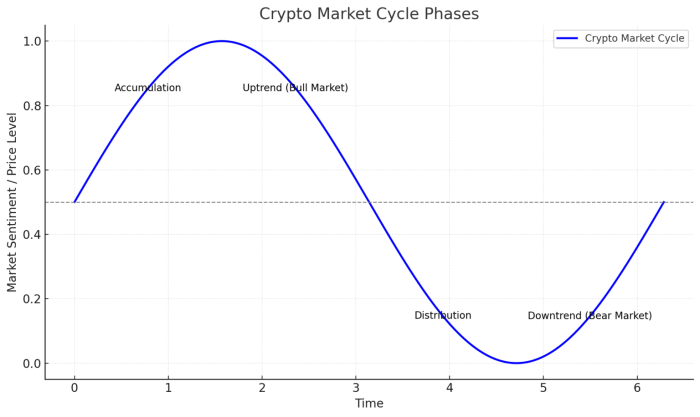
Here’s a breakdown of the typical phases of a crypto cycle:
| Phase | Characteristics | Investor Sentiment | Typical Duration |
|---|---|---|---|
| Accumulation | Sideways trading, low volume, consolidation after a bear market. Projects building, development activity high. | Skepticism, fear, disbelief. “This is a dead cat bounce.” | 6-18 months |
| Markup | Rapidly increasing prices, high volume, widespread media attention. New all-time highs. | Greed, euphoria, FOMO (Fear Of Missing Out). “To the moon!” | 6-12 months |
| Distribution | Price consolidation, increasing volatility, large holders (whales) taking profits. | Cautious optimism, uncertainty. “Is this the top?” | 3-6 months |
| Markdown | Rapid price decline, panic selling, negative news headlines. | Fear, despair, capitulation. “Everything is going to zero!” | 3-12 months |
Identifying Phases of a Cryptocurrency Cycle
Source: helalabs.com
Recognizing which phase of the cycle we’re in is crucial for making informed investment decisions. This involves a combination of technical analysis, on-chain data analysis, and sentiment analysis.
Technical indicators can provide clues. Moving averages can help identify trends and potential support/resistance levels. The Relative Strength Index (RSI) can indicate overbought or oversold conditions. The Moving Average Convergence Divergence (MACD) can signal potential trend reversals. However, no single indicator is foolproof; it’s best to use them in conjunction.
On-chain data offers a more fundamental view. Analyzing transaction volume can reveal whether activity is increasing or decreasing. Tracking active addresses can indicate the level of network adoption. Monitoring exchange flows – the movement of coins into and out of exchanges – can provide insights into buying and selling pressure. A surge in coins flowing
-into* exchanges often precedes a price decline, while a surge
-out* of exchanges can suggest accumulation.
Sentiment indicators, while subjective, can be valuable. Monitoring social media trends (Twitter, Reddit) and news headlines can gauge the overall market mood. A sudden shift from positive to negative sentiment can be a warning sign. Here’s a list of observable patterns during each phase:
- Accumulation: Sideways trading range, low trading volume, negative news dominating headlines, projects quietly building.
- Markup: Consistent price increases, increasing trading volume, positive news coverage, widespread media attention.
- Distribution: Price consolidation, increasing volatility, sideways movement with occasional rallies and pullbacks, whales taking profits.
- Markdown: Rapid price decline, panic selling, negative news amplifying the downturn, widespread fear and despair.
Factors Extending or Shortening Cycles
The duration of a crypto cycle isn’t fixed. Macroeconomic events can significantly impact the timeline. For example, high inflation can lead to increased risk aversion, potentially shortening a bull market. Conversely, lower interest rates can encourage investment in riskier assets like crypto, potentially extending a bull market. Geopolitical instability can also introduce uncertainty and volatility.
Major project launches or technological breakthroughs can accelerate a cycle. The launch of a highly anticipated decentralized finance (DeFi) protocol, for instance, can spark a rally. Similarly, a significant upgrade to the Ethereum blockchain could boost investor confidence. Regulatory announcements, both positive and negative, can have a profound impact. A clear and favorable regulatory framework can attract institutional investment and extend a bull market, while a crackdown on crypto can trigger a sell-off.
Liquidity and market depth play a crucial role in the speed of price movements during cycles. Low liquidity means that even relatively small buy or sell orders can have a significant impact on price. Conversely, high liquidity allows for larger trades to be absorbed without causing dramatic price swings. A lack of market depth – the availability of buy and sell orders at various price levels – can exacerbate volatility during both bull and bear markets.
The Role of Bitcoin in Crypto Cycles
Bitcoin often acts as a leading indicator for the broader cryptocurrency market. Historically, Bitcoin has tended to bottom out
-before* altcoins, and its price movements often foreshadow trends in the altcoin market. This is due to Bitcoin’s dominance in terms of market capitalization and its role as the first and most well-known cryptocurrency.
Bitcoin’s halving events – which occur approximately every four years and reduce the reward for mining new blocks – have historically correlated with cycle peaks and bottoms. The reduced supply of new Bitcoin, combined with continued demand, often leads to price appreciation in the months following a halving. While not a perfect predictor, the halving cycle is a significant factor to consider.
Bitcoin dominance – the percentage of the total cryptocurrency market capitalization represented by Bitcoin – also provides valuable insights. During bear markets, investors often flock to Bitcoin as a “safe haven,” increasing its dominance. During bull markets, altcoins tend to outperform Bitcoin, decreasing its dominance. A rising Bitcoin dominance can signal the end of an altcoin season and the beginning of a more risk-off environment.
Imagine a chart illustrating Bitcoin’s price movements over multiple cycles. The x-axis represents time, and the y-axis represents price. Each cycle would show a similar pattern: a period of accumulation, followed by a rapid markup, a period of distribution, and a sharp markdown. Annotations would highlight key events – halving events, major market corrections, and significant regulatory announcements. The overall message of the chart would be the cyclical nature of Bitcoin’s price and the importance of understanding these patterns.
Altcoin Behavior Within Cycles
Altcoins – all cryptocurrencies other than Bitcoin – generally exhibit more volatile price movements than Bitcoin. Their performance varies significantly depending on their market capitalization and the stage of the cycle. Large-cap altcoins (e.g., Ethereum, Solana) tend to be more stable and follow Bitcoin’s lead, while mid-cap and small-cap altcoins are more prone to dramatic gains and losses.
“Altcoin seasons” – periods where altcoins significantly outperform Bitcoin – typically occur during the later stages of a bull market. This is when investors are willing to take on more risk in search of higher returns. Factors that trigger altcoin seasons include increased liquidity, positive news about specific altcoin projects, and a general sense of euphoria in the market.
Identifying promising altcoins requires careful research. Look for projects with strong fundamentals, a dedicated development team, a clear use case, and a growing community. Pay attention to on-chain metrics, such as transaction volume and active addresses. However, remember that altcoin investing is inherently riskier than Bitcoin investing.
| Altcoin Category | Accumulation Phase | Markup Phase | Distribution Phase |
|---|---|---|---|
| Large-Cap | Moderate gains, relatively stable. | Strong gains, following Bitcoin’s lead. | Consolidation, potential for sideways trading. |
| Mid-Cap | Higher risk/reward, potential for significant gains. | Outperformance of large-cap altcoins. | Increased volatility, potential for sharp corrections. |
| Small-Cap | Very high risk/reward, potential for exponential gains. | Extreme gains, but also high risk of failure. | Significant volatility, potential for complete loss of investment. |
Risk Management During Market Cycles
Navigating market cycles requires a disciplined approach to risk management. Position sizing – determining how much of your portfolio to allocate to each asset – is crucial. Diversification – spreading your investments across different assets – can help mitigate risk. Never invest more than you can afford to lose.
Setting stop-loss orders – automated sell orders that trigger when an asset reaches a certain price – can help limit potential losses. Taking profits – selling a portion of your holdings when an asset reaches a target price – can help lock in gains. Dollar-cost averaging – investing a fixed amount of money at regular intervals – can help smooth out price fluctuations.
Assessing your personal risk tolerance is essential. Are you comfortable with the possibility of losing a significant portion of your investment? Or do you prefer a more conservative approach? Your investment strategy should align with your risk tolerance and financial goals.
Tools for Tracking and Analyzing Cycles
Numerous charting platforms and data providers can help you track and analyze market cycles. TradingView is a popular choice, offering a wide range of technical indicators and charting tools. CoinMarketCap and CoinGecko provide data on cryptocurrency prices, market capitalization, and trading volume. Glassnode and Nansen offer access to on-chain data and advanced analytics.
Resources for accessing sentiment indicators include Twitter, Reddit, and news aggregators. LunarCrush provides a platform for tracking social media sentiment related to cryptocurrencies. However, remember that sentiment indicators are subjective and should be used with caution.
Each analytical tool has its benefits and limitations. Charting platforms are useful for identifying technical patterns, but they don’t provide fundamental insights. On-chain data analysis can reveal underlying trends, but it can be complex and require specialized knowledge. Sentiment analysis can gauge market mood, but it’s prone to manipulation.
- Free Resources: TradingView (basic plan), CoinMarketCap, CoinGecko, Twitter, Reddit.
- Paid Resources: Glassnode, Nansen, LunarCrush, TradingView (premium plan).
Cycle Psychology and Investor Behavior
Understanding the psychological biases that affect investment decisions is crucial for avoiding costly mistakes. Confirmation bias – the tendency to seek out information that confirms your existing beliefs – can lead you to ignore warning signs. Anchoring bias – the tendency to rely too heavily on the first piece of information you receive – can distort your perception of value.
Loss aversion – the tendency to feel the pain of a loss more strongly than the pleasure of an equivalent gain – can lead to irrational selling decisions.
Fear and greed are powerful emotions that can drive irrational market behavior. During a bull market, greed can lead investors to chase returns without considering the risks. During a bear market, fear can lead to panic selling, exacerbating the downturn. Maintaining emotional discipline is essential for making rational investment decisions.
A long-term perspective is crucial. Market cycles are inevitable, and attempting to time the market is often futile. Focus on the fundamentals of the assets you invest in and avoid making impulsive decisions based on short-term price fluctuations.
Advanced Cycle Concepts

Source: asicmarketplace.com
Fractal patterns – repeating patterns that occur at different scales – are common in cryptocurrency markets. This means that the same patterns that play out over years can also be observed over months or weeks. Recognizing these fractal patterns can help you anticipate future price movements.
Overlapping cycles – when multiple cycles are occurring simultaneously – can create complex market dynamics. For example, a Bitcoin halving cycle might overlap with a macroeconomic cycle, leading to unpredictable price movements. Understanding these interactions requires a deep understanding of both technical and fundamental analysis.
Liquidity traps – situations where monetary policy becomes ineffective because interest rates are already near zero – can prolong bear markets. In a liquidity trap, investors are unwilling to invest, even at low interest rates, leading to a prolonged period of economic stagnation.
The Wyckoff Accumulation/Distribution schematic is a powerful tool for identifying cycle turning points. It describes the phases of accumulation and distribution, highlighting the actions of “smart money” (institutional investors) and “dumb money” (retail investors). By understanding the Wyckoff schematic, you can gain insights into the intentions of market participants and anticipate potential price movements.
Closing Summary
So, we’ve journeyed through the fascinating world of crypto market cycles, from the foundational principles to the nuances of altcoin behavior. Remember, these cycles aren’t rigid timelines, but rather tendencies shaped by a complex interplay of factors. The key takeaway? Awareness. By understanding the phases, recognizing the signals, and managing your risk, you can move beyond simply reacting to the market and start proactively navigating it.
Ultimately, successful crypto investing isn’t about timing the market perfectly – it’s about understanding
-where* you are in the cycle and adjusting your strategy accordingly. Stay informed, stay disciplined, and remember that long-term perspective is your greatest asset. The cycles will continue, but with knowledge and preparation, you can ride them to your advantage.
Question Bank
What’s the biggest difference between crypto cycles and traditional market cycles?
Crypto cycles tend to be much faster and more volatile than those in traditional markets like stocks or real estate. This is due to the 24/7 nature of crypto trading, higher retail participation, and the relatively smaller market capitalization compared to established asset classes.
How can I use on-chain data to confirm a cycle bottom?
Look for increasing active addresses, rising transaction volume, and a decrease in coins held on exchanges. These indicators suggest renewed interest and accumulation, potentially signaling the end of a downtrend.
What is Bitcoin dominance and why is it important?
Bitcoin dominance refers to the percentage of the total cryptocurrency market capitalization that is held by Bitcoin. A rising dominance often indicates a risk-off environment where investors are flocking to Bitcoin as a safe haven, while a falling dominance suggests altcoins are gaining favor.
Is dollar-cost averaging (DCA) really effective during a bear market?
Yes, DCA can be a very effective strategy during a bear market. By investing a fixed amount of money at regular intervals, you reduce the risk of buying at the peak and average out your purchase price over time.
How do I avoid emotional decision-making during a market crash?
Develop a pre-defined investment plan and stick to it. Avoid checking your portfolio constantly, and remind yourself of your long-term goals. Consider using stop-loss orders to automatically limit your losses.
