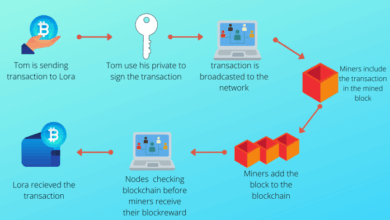
Ever wondered what keeps Bitcoin ticking? It’s not magic, it’s mining! And it’s a fascinating process that underpins the entire system. We’re diving deep into the world of Bitcoin mining, breaking down how it works, why it’s important, and what the future might hold. It’s a bit technical, sure, but I’ll try to keep things as clear and straightforward as possible.
Think of it as unlocking the secrets behind digital gold.




Bitcoin mining isn’t about digging in the ground; it’s about solving complex computational puzzles to verify transactions and add new blocks to the blockchain. Miners are essentially the backbone of the Bitcoin network, ensuring its security and reliability. This guide will walk you through everything from the basics of Proof of Work to the nitty-gritty details of mining hardware and pools.
Let’s get started!
How Bitcoin Mining Works: A Deep Dive into Proof of Work
Bitcoin mining often feels like a mysterious process shrouded in technical jargon. But at its core, it’s the engine that keeps the Bitcoin network running, verifying transactions and ensuring its security. This guide aims to demystify Bitcoin mining, breaking down the complex concepts into understandable terms. We’ll explore everything from the historical evolution of mining to the hardware involved, the economics that drive it, and the environmental considerations surrounding it.
Understanding Bitcoin mining isn’t just about understanding the technology; it’s about understanding the fundamental principles of a decentralized, trustless system. It’s a fascinating intersection of cryptography, economics, and computer science, and it’s crucial for anyone looking to truly grasp the potential of Bitcoin.
Introduction to Bitcoin Mining
Bitcoin mining serves as the backbone of the Bitcoin network, responsible for processing and verifying transactions. Without miners, the network wouldn’t function. They aren’t simply creating new Bitcoins; they’re providing a vital security service.
Miners bundle recent transactions into blocks, then compete to solve a complex cryptographic puzzle. The first miner to solve the puzzle gets to add the block to the blockchain, the public ledger of all Bitcoin transactions. This process validates the transactions within the block, making them permanent and tamper-proof. This validation is crucial because it prevents double-spending – the risk of someone spending the same Bitcoin twice.
In the early days of Bitcoin, mining could be done on a standard home computer CPU. As the network grew and more miners joined, the difficulty of the puzzle increased, requiring more powerful hardware. This led to the use of GPUs, then FPGAs, and eventually, specialized ASICs (Application-Specific Integrated Circuits) designed solely for Bitcoin mining.
The incentive for miners comes in two forms: the block reward, which is newly created Bitcoin awarded to the miner who successfully adds a block to the blockchain, and transaction fees, which are small amounts of Bitcoin paid by users to prioritize their transactions. Currently, the block reward is 6.25 BTC, but this is halved approximately every four years, a process known as the halving.
Transaction fees fluctuate based on network congestion.
Understanding Proof of Work (PoW)
Proof of Work (PoW) is the consensus mechanism that Bitcoin uses to secure its network. It’s a system that requires miners to expend computational effort to solve a complex problem, proving they’ve invested resources in the network. This makes it incredibly difficult and expensive for anyone to attack the network.
The core principle behind PoW is that it makes double-spending impractical. To double-spend, an attacker would need to create a fraudulent block and then outpace the rest of the network in solving subsequent blocks. This would require controlling more than 50% of the network’s hashing power, a scenario known as a 51% attack, which is extremely costly and unlikely.
The cryptographic puzzle miners solve involves finding a hash – a unique fingerprint – for the block that meets certain criteria. This is done by repeatedly changing a piece of data in the block called the “nonce” and recalculating the hash until a valid one is found. The difficulty of the puzzle is adjusted dynamically to maintain an average block time of 10 minutes.
Here’s a comparison of Proof of Work with another popular consensus mechanism, Proof of Stake:
| Consensus Mechanism | Energy Consumption | Security | Scalability |
|---|---|---|---|
| Proof of Work (PoW) | High | Very High (requires significant resources to attack) | Low (limited transaction throughput) |
| Proof of Stake (PoS) | Low | Moderate (security relies on stake ownership) | High (potentially faster transaction throughput) |
The Mining Process: Step-by-Step
The process of Bitcoin mining is a carefully orchestrated sequence of steps. It begins with gathering transactions and culminates in the potential addition of a new block to the blockchain.
First, miners collect pending Bitcoin transactions from the network. These transactions are waiting to be confirmed and added to the blockchain. They then organize these transactions into a block. To ensure data integrity, miners create a Merkle tree from these transactions. A Merkle tree is a hierarchical data structure where each leaf node represents a transaction, and each non-leaf node is a hash of its child nodes.
This allows for efficient verification of transaction inclusion.
The miner then adds a header to the block, which includes information like the previous block’s hash, a timestamp, and the Merkle root (the hash of the Merkle tree). Crucially, the miner also adds a “nonce” – an arbitrary number. The miner’s goal is to find a nonce that, when combined with the rest of the block header and hashed, produces a hash value below a certain target.
This target is determined by the network’s difficulty.
Miners repeatedly change the nonce and recalculate the hash. This is a brute-force process, requiring immense computational power. They are essentially guessing different nonce values until they find one that results in a valid hash. Once a valid hash is found, the miner broadcasts the block to the network. Other nodes then verify the block’s validity before adding it to their copy of the blockchain.
Mining Hardware: From CPUs to ASICs
Source: ecoinomy.eu
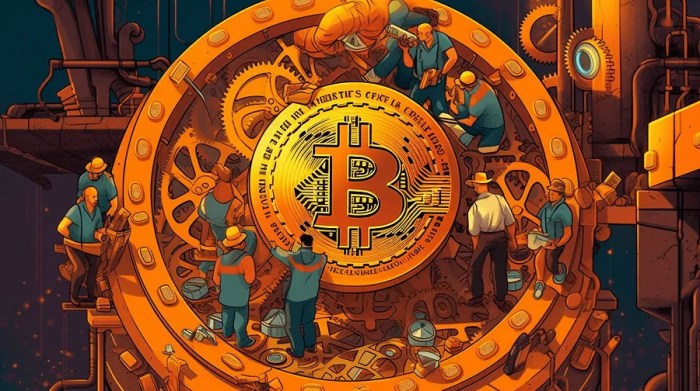
The evolution of Bitcoin mining hardware has been dramatic, driven by the increasing difficulty of the mining puzzle. What started with readily available components quickly transitioned to specialized equipment.
Initially, Bitcoin mining was done using CPUs (Central Processing Units), the same processors found in everyday computers. However, CPUs are not efficient at the type of calculations required for mining. GPUs (Graphics Processing Units), originally designed for rendering graphics, proved to be much more effective due to their parallel processing capabilities. Next came FPGAs (Field-Programmable Gate Arrays), which are customizable chips that can be programmed to perform specific tasks, offering even greater efficiency than GPUs.
Today, the dominant hardware for Bitcoin mining is ASICs (Application-Specific Integrated Circuits). ASICs are chips designed specifically for the SHA-256 hashing algorithm used in Bitcoin. They offer the highest hash rate and energy efficiency, but they are also the most expensive and have a limited lifespan as newer, more powerful ASICs are released.
Here’s a look at the specifications of some popular ASIC miners:
| Miner Model | Hash Rate (TH/s) | Power Consumption (Watts) | Approximate Price (USD) |
|---|---|---|---|
| Bitmain Antminer S19 Pro | 110 | 3250 | 9,000 – 12,000 |
| Whatsminer M30S++ | 112 | 3472 | 8,000 – 10,000 |
| Canaan AvalonMiner 1246 | 90 | 3420 | 6,000 – 8,000 |
Mining Pools: Collaborative Mining
As mining difficulty increased, solo mining – attempting to find a block on your own – became increasingly unlikely for most individuals. This led to the rise of mining pools, where miners combine their computational resources to increase their chances of finding a block.
In a mining pool, miners contribute their hashing power to a shared effort. When the pool successfully finds a block, the reward is distributed among the participants based on the amount of hashing power they contributed. This provides a more consistent, albeit smaller, income stream compared to the unpredictable nature of solo mining.
Mining pools typically charge a fee for their services, ranging from 1% to 3%. Payout methods vary, with some pools paying out daily, while others pay out when a certain threshold is reached. Choosing a pool involves considering factors like fee structure, payout frequency, pool size, and server location.
Here are some of the largest Bitcoin mining pools:
- Antpool: Hash Rate: ~20% , Estimated Payout Rate: Varies
- Poolin: Hash Rate: ~15% , Estimated Payout Rate: Varies
- F2Pool: Hash Rate: ~10% , Estimated Payout Rate: Varies
- BTC.com: Hash Rate: ~8% , Estimated Payout Rate: Varies
Difficulty Adjustment and Block Time
The Bitcoin network dynamically adjusts the mining difficulty to maintain an average block time of 10 minutes. This adjustment is crucial for the stability and predictability of the network.
Every 2016 blocks (approximately two weeks), the network recalculates the difficulty based on the time it took to mine the previous 2016 blocks. If the blocks were mined faster than 10 minutes on average, the difficulty increases, making it harder to find new blocks. Conversely, if the blocks were mined slower than 10 minutes on average, the difficulty decreases, making it easier.
Factors that influence the difficulty adjustment include the total hashing power of the network. As more miners join the network, the total hashing power increases, leading to a higher difficulty. Conversely, if miners leave the network, the total hashing power decreases, leading to a lower difficulty.
The difficulty adjustment directly impacts miner profitability. A higher difficulty means miners need to expend more resources to find a block, reducing their potential revenue. A lower difficulty makes it easier to find blocks, increasing potential revenue.
Energy Consumption and Environmental Concerns
Bitcoin mining is a computationally intensive process that requires significant energy consumption. This has raised concerns about its environmental impact.
The energy consumption of the Bitcoin network is comparable to that of some small countries. The majority of this energy is currently used to power ASICs and cooling systems. The environmental impact stems primarily from the carbon emissions associated with electricity generation, particularly when fossil fuels are used.
However, there is a growing trend towards using renewable energy sources in Bitcoin mining. Some miners are locating their operations near hydroelectric dams, solar farms, and wind farms to reduce their carbon footprint. There’s also research into more energy-efficient mining hardware and cooling technologies.
“The debate surrounding Bitcoin’s sustainability is complex. Critics point to its high energy consumption and carbon emissions, while proponents argue that it incentivizes the development of renewable energy infrastructure and can even help stabilize electricity grids.”
Mining Farms and Infrastructure
Large-scale Bitcoin mining operations, known as mining farms, require significant infrastructure to operate efficiently.
A typical mining farm consists of rows upon rows of ASICs, housed in a climate-controlled environment. Cooling is essential to prevent the ASICs from overheating and failing. This is often achieved using air conditioning systems or immersion cooling, where the ASICs are submerged in a dielectric fluid. Power is another critical requirement, and mining farms often need dedicated high-voltage power lines.
Reliable network connectivity is also essential for communicating with the Bitcoin network.
The location of mining farms is influenced by several factors, including the cost of electricity, climate, and regulatory environment. Regions with cheap and abundant renewable energy sources are particularly attractive. Cool climates can reduce cooling costs, and favorable regulations can streamline operations.
Imagine a large warehouse filled with rows of metal racks. Each rack holds dozens of ASICs, humming with activity. Large fans circulate air to dissipate heat, and thick cables deliver power to each machine. A control room monitors the farm’s performance, tracking hash rate, temperature, and power consumption.
Block Rewards and Halving Events
Block rewards are the primary incentive for miners to participate in the Bitcoin network. They represent newly created Bitcoin awarded to the miner who successfully adds a block to the blockchain.
The block reward started at 50 BTC in 2009 and is halved approximately every four years. These events, known as halvings, reduce the rate at which new Bitcoin are created. The most recent halving occurred in May 2020, reducing the block reward to 6.25 BTC. The next halving is expected in 2024, reducing the block reward to 3.125 BTC.
Halving events have a significant impact on miner revenue. As the block reward decreases, miners rely more on transaction fees to cover their costs. This can lead to increased transaction fees during periods of high network congestion. The long-term implications of decreasing block rewards are that mining will eventually become solely reliant on transaction fees, requiring a robust and widely used Bitcoin network to sustain it.
Here’s a timeline of past and future Bitcoin halving events:
- November 28, 2012: Block Reward: 25 BTC
- July 9, 2016: Block Reward: 12.5 BTC
- May 11, 2020: Block Reward: 6.25 BTC
- April 2024 (estimated): Block Reward: 3.125 BTC
Mining Software and Configuration
Source: staticimgs.com
Bitcoin mining requires specialized software to connect to the network, manage hardware, and monitor performance.
Popular mining software options include CGMiner, BFGMiner, and EasyMiner. These programs allow miners to configure their hardware, connect to a mining pool, and track their earnings. Configuring mining software typically involves specifying the mining pool’s address, your worker name, and your Bitcoin wallet address.
Monitoring mining performance is crucial for identifying and resolving issues. Key metrics to track include hash rate, temperature, and power consumption. Troubleshooting common problems, such as hardware failures or network connectivity issues, is an essential part of being a successful miner.
Here’s a list of essential mining software and their functions:
- CGMiner: Command-line mining software, highly customizable.
- BFGMiner: Another command-line miner, supports multiple mining algorithms.
- EasyMiner: Graphical user interface (GUI) miner, easier to use for beginners.
Last Word
Source: relai.app
So, there you have it – a comprehensive look at how Bitcoin mining works! It’s a complex system, driven by cryptography, competition, and a whole lot of computing power. While the energy consumption is a valid concern, the innovation around renewable energy sources and more efficient hardware is promising. Understanding the core principles of Proof of Work and the role miners play is crucial to grasping the true potential of Bitcoin.
The world of Bitcoin mining is constantly evolving, with new technologies and challenges emerging all the time. Hopefully, this guide has given you a solid foundation to continue exploring this exciting space. It’s more than just a technical process; it’s a fundamental part of a revolutionary financial system. Keep learning, stay curious, and who knows – maybe you’ll even consider joining the mining community!
FAQ Resource
What happens if two miners find a valid block at almost the same time?
This is where the blockchain’s consensus mechanism really shines. The network will recognize only one block as valid – the one that gets included in the longest chain. The other block becomes an “orphan” block and is discarded, but the miner who found it still receives a transaction fee for the transactions included within it.
Is Bitcoin mining profitable for the average person?
It’s increasingly difficult. The cost of electricity and specialized hardware (ASICs) is high. Unless you have access to very cheap electricity and can invest in the latest equipment, it’s unlikely to be profitable. Joining a mining pool is a more realistic option for smaller miners.
What is a 51% attack and how does Proof of Work prevent it?
A 51% attack occurs when a single entity controls more than half of the network’s hashing power. This would allow them to potentially manipulate transactions. Proof of Work makes this incredibly expensive and difficult because it would require an enormous amount of computing power and energy to consistently outpace the rest of the network.
How does the difficulty adjustment work in practice?
Every 2016 blocks (roughly every two weeks), the Bitcoin network recalculates the mining difficulty. If blocks are being mined faster than 10 minutes on average, the difficulty increases, making it harder to find a valid hash. If blocks are taking longer than 10 minutes, the difficulty decreases. This ensures a consistent block time, regardless of how much hashing power is on the network.
Can I mine Bitcoin on my laptop?
Technically, yes, but it’s not practical. CPUs and GPUs are far less efficient than ASICs. You’d consume a lot of electricity and generate very little Bitcoin, making it a waste of resources. It’s best to leave Bitcoin mining to those with dedicated hardware and access to affordable power.