Okay, let’s be real – Bitcoin. You’ve heard the buzz, maybe seen the price swings, but do you
-actually* understand what’s going on under the hood? It feels complicated, and honestly, it can be. But at its core, Bitcoin is a fascinating innovation, a digital revolution built on a surprisingly elegant idea: the blockchain. This isn’t just about getting rich quick; it’s about rethinking how we handle money and trust in the digital age.
We’ll break down everything from Bitcoin’s origins and the problems it aimed to solve, to the nitty-gritty details of transactions, mining, and the technology that makes it all possible. Think of it as a journey from the “why” to the “how,” demystifying the world of cryptocurrency one block at a time. We’ll explore how this decentralized system operates, and why so many people are excited about its potential.






Introduction to Digital Currency & Bitcoin’s Origins
We’re living in an increasingly digital world, and money is no exception. The idea of currency existing purely as digital data, without physical form, isn’t new. Think about the numbers in your bank account – those are already digital representations of value. But digital currency, as we now understand it, goes a step further, aiming to remove the middleman – the banks – and give individuals more control over their finances.
Bitcoin was the first, and remains the most well-known, example of this new paradigm.
Before Bitcoin, traditional financial systems were often criticized for their centralized control, lack of transparency, and susceptibility to manipulation. Fees for international transactions could be high, and processing times slow. The 2008 financial crisis exposed vulnerabilities in the system, fueling a desire for an alternative. Bitcoin emerged as a response to these issues, promising a decentralized, transparent, and secure way to transact.
Bitcoin’s Creation & Satoshi Nakamoto
In 2008, a whitepaper titled “Bitcoin: A Peer-to-Peer Electronic Cash System” was published under the pseudonym Satoshi Nakamoto. This paper Artikeld the principles of a revolutionary new currency. The identity of Satoshi Nakamoto remains a mystery to this day, despite numerous attempts to unmask them. Some believe it’s a single person, others a group. What’s clear is that they possessed a deep understanding of cryptography, economics, and distributed systems.
The initial motivations behind Bitcoin weren’t just about creating a new currency. It was also about establishing a system free from censorship and control by governments or financial institutions. The philosophical underpinnings are rooted in cypherpunk ideals – a belief in using cryptography to protect individual privacy and freedom. Bitcoin was designed to be a trustless system, meaning you don’t need to
-trust* a central authority; the system itself enforces the rules.
The Blockchain: A Distributed Ledger
At the heart of Bitcoin lies the blockchain. It’s often described as a revolutionary technology, and for good reason. But what
-is* it? Simply put, the blockchain is a public, immutable, and distributed ledger. Think of a ledger as a record book of transactions.
In traditional finance, this ledger is maintained by a central authority, like a bank. With Bitcoin, the ledger is distributed across a network of computers, making it incredibly secure and transparent.
Each “page” in this ledger is called a block. These blocks are chained together chronologically and cryptographically, meaning each block contains a piece of information that links it to the previous block. This creates a permanent and tamper-proof record of all transactions. Any attempt to alter a block would require altering all subsequent blocks, which is computationally infeasible.
Centralized Databases vs. Blockchain
To better understand the benefits of blockchain, let’s compare it to a traditional centralized database:
| Feature | Centralized Database | Blockchain | Security Level |
|---|---|---|---|
| Control | Single entity | Distributed network | Low to Medium |
| Transparency | Limited | High (public blockchains) | Medium |
| Immutability | Data can be altered | Data is tamper-proof | High |
| Single Point of Failure | Yes | No | Low |
The benefits of a distributed ledger system are significant. Transparency allows anyone to verify transactions, while immutability ensures the integrity of the data. The lack of a single point of failure makes the system incredibly resilient to attacks and censorship. This inherent security is a key reason why Bitcoin has gained so much traction.
Bitcoin Transactions: From Input to Output
Let’s break down how a Bitcoin transaction actually works. It’s more complex than simply sending money from one account to another. Bitcoin transactions are built on a system of inputs and outputs. Think of it like paying with cash – you give the cashier money (input), and they give you change (output). The difference between the two is the amount of the purchase.
Each transaction specifies the Bitcoin addresses from which the funds are coming (inputs) and the Bitcoin addresses to which the funds are going (outputs). The total value of the inputs must equal or exceed the total value of the outputs. Any difference is returned as “change” to the sender’s address.
Digital Signatures & Transaction Authenticity
To ensure that transactions are legitimate and haven’t been tampered with, Bitcoin uses digital signatures. These signatures are created using cryptography and are unique to each transaction. When you send Bitcoin, your private key is used to create a digital signature that proves you own the funds you’re sending. Anyone can verify this signature using your public key, without needing to know your private key.
Here’s a step-by-step walkthrough of a typical Bitcoin transaction:
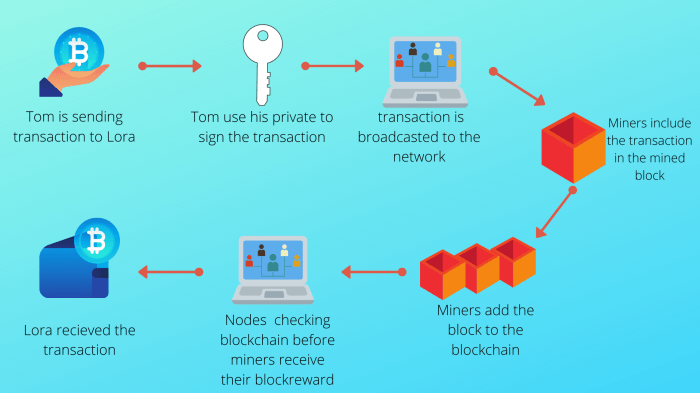
- You initiate a transaction from your Bitcoin wallet, specifying the recipient’s address and the amount of Bitcoin you want to send.
- Your wallet creates a transaction message containing the inputs, outputs, and amount.
- Your wallet uses your private key to digitally sign the transaction message.
- The signed transaction is broadcast to the Bitcoin network.
- Miners verify the transaction and include it in a block.
- Once the block is added to the blockchain, the transaction is confirmed.
UTXOs: Unspent Transaction Outputs
Bitcoin doesn’t track balances like a traditional bank account. Instead, it uses a system called UTXOs (Unspent Transaction Outputs). Each transaction creates UTXOs, which represent the remaining Bitcoin after a transaction. When you send Bitcoin, you’re essentially spending existing UTXOs. Your wallet combines multiple UTXOs to meet the required amount, and any leftover Bitcoin is returned to you as a new UTXO.
Understanding UTXOs is crucial for understanding how Bitcoin manages its state.
Mining: Securing the Network & Creating New Bitcoin
Bitcoin mining is the process of verifying and adding new transactions to the blockchain. It’s a critical component of the Bitcoin network, as it secures the system and creates new Bitcoin. Miners compete to solve a complex cryptographic puzzle, and the first miner to solve the puzzle gets to add the next block to the blockchain and receive a reward in the form of newly minted Bitcoin and transaction fees.
This process isn’t about finding something; it’s about expending computational power to find a specific solution – a hash – that meets certain criteria. The difficulty of the puzzle adjusts automatically to ensure that new blocks are added to the blockchain approximately every 10 minutes.
Proof-of-Work (PoW) & Its Challenges
Bitcoin uses a consensus mechanism called Proof-of-Work (PoW). This means that miners must
-prove* they’ve expended computational effort to solve the puzzle. PoW is effective at securing the network, but it’s also energy-intensive. The amount of electricity consumed by Bitcoin mining has been a subject of debate and concern. Alternative consensus mechanisms, like Proof-of-Stake, are being explored to address these concerns.
Mining Hardware: CPU, GPU, ASIC
Over time, the hardware used for Bitcoin mining has evolved. Initially, CPUs (Central Processing Units) were used. However, GPUs (Graphics Processing Units) proved to be much more efficient at performing the calculations required for mining. Eventually, ASICs (Application-Specific Integrated Circuits) were developed – specialized hardware designed solely for Bitcoin mining. ASICs are by far the most efficient, but they are also expensive and quickly become obsolete.
Solving the Cryptographic Hash Puzzle
Here are the key steps involved in solving a cryptographic hash puzzle:
- Gather a set of recent transactions.
- Combine these transactions with the previous block’s hash and a random number called a “nonce.”
- Hash the combined data using the SHA-256 algorithm.
- Check if the resulting hash meets the target difficulty.
- If the hash doesn’t meet the target, change the nonce and repeat steps 3 and 4.
- The first miner to find a hash that meets the target difficulty wins the right to add the block to the blockchain.
Blocks & Block Headers: The Building Blocks of the Blockchain
As we’ve discussed, the blockchain is made up of blocks. Each block contains a set of transactions, along with some metadata that links it to the previous block. The block header is a crucial part of each block, as it contains information that is used to create a unique fingerprint of the block.
The block header is essentially a summary of the block’s contents. It’s used to verify the integrity of the block and to link it to the previous block in the chain. Without the block header, the blockchain wouldn’t be possible.
Components of a Bitcoin Block Header
The block header contains several important fields:
- Version: Indicates the block version number.
- Previous Block Hash: A cryptographic hash of the previous block’s header, linking the blocks together.
- Merkle Root: A hash of all the transactions in the block, providing a concise summary of the block’s contents.
- Timestamp: The time the block was created.
- Difficulty Target: Specifies the difficulty of the mining puzzle.
- Nonce: A random number used to vary the hash of the block header until a valid hash is found.
The Significance of Nonce, Timestamp & Previous Block Hash
The nonce is particularly important. Miners adjust the nonce until the hash of the block header meets the difficulty target. The timestamp provides a chronological order to the blocks. The previous block hash is what creates the chain – it’s the link that connects each block to the one before it. Any change to the previous block would change its hash, invalidating all subsequent blocks.
Creating a Unique Fingerprint of the Block
The block header is hashed using the SHA-256 algorithm to create a unique fingerprint of the block. This hash is a fixed-size string of characters that represents the block’s contents. Even a small change to the block header will result in a completely different hash. This is how the blockchain ensures data integrity.
Imagine the block header as a recipe. The ingredients are the version, previous block hash, Merkle root, timestamp, difficulty target, and nonce. The SHA-256 algorithm is the oven. No matter how many times you bake the same recipe, you’ll get the same cake (hash). But if you change even one ingredient, you’ll get a different cake.
Cryptography in Bitcoin: Hashing & Encryption
Cryptography is the foundation of Bitcoin’s security. It’s used to secure transactions, verify identities, and ensure the integrity of the blockchain. Two key cryptographic concepts are hashing and encryption.
Hashing is a one-way function that takes an input and produces a fixed-size output called a hash. It’s impossible to reverse the process – you can’t determine the input from the hash. Encryption, on the other hand, is a two-way function that transforms data into an unreadable format (ciphertext) and back again (plaintext) using a key.
Cryptographic Hash Functions (SHA-256)
Bitcoin uses the SHA-256 (Secure Hash Algorithm 256-bit) hash function. SHA-256 takes any input and produces a 256-bit hash. It’s designed to be collision-resistant, meaning it’s extremely difficult to find two different inputs that produce the same hash. This property is crucial for ensuring the integrity of the blockchain.
Data Integrity & Immutability
Hashing ensures data integrity because any change to the input data will result in a different hash. This allows anyone to verify that data hasn’t been tampered with. Immutability is achieved by chaining blocks together using their hashes. If someone tries to alter a block, the hash will change, breaking the chain and alerting the network.
Public-Key Cryptography & Secure Transactions
Bitcoin uses public-key cryptography to secure transactions. Each user has a pair of keys: a public key and a private key. The public key is like your account number – you can share it with anyone. The private key is like your password – you must keep it secret. When you send Bitcoin, you use your private key to digitally sign the transaction.
Anyone can verify the signature using your public key, proving that you authorized the transaction.
Generating a Bitcoin Address
A Bitcoin address is derived from your public key using a series of cryptographic transformations. This process ensures that your public key is not directly exposed, adding an extra layer of security. The address is what you share with others to receive Bitcoin.
Nodes & the Bitcoin Network
The Bitcoin network is a peer-to-peer (P2P) network, meaning there’s no central server controlling the system. Instead, the network is made up of thousands of computers, called nodes, that communicate directly with each other. These nodes work together to maintain the blockchain and verify transactions.
Each node stores a copy of the blockchain and participates in the consensus process. The more nodes there are, the more secure and resilient the network becomes.
Types of Nodes: Full, Light, & Mining
There are different types of nodes in the Bitcoin network:
- Full Nodes: These nodes store the entire blockchain and verify all transactions. They are the backbone of the network, ensuring its security and integrity.
- Light Nodes (SPV Nodes): These nodes only download block headers, not the full blockchain. They rely on full nodes to verify transactions. They are less resource-intensive but also less secure.
- Mining Nodes: These nodes perform the mining process, competing to solve the cryptographic puzzle and add new blocks to the blockchain.
Node Communication & Blockchain Synchronization
Source: tastycrypto.com
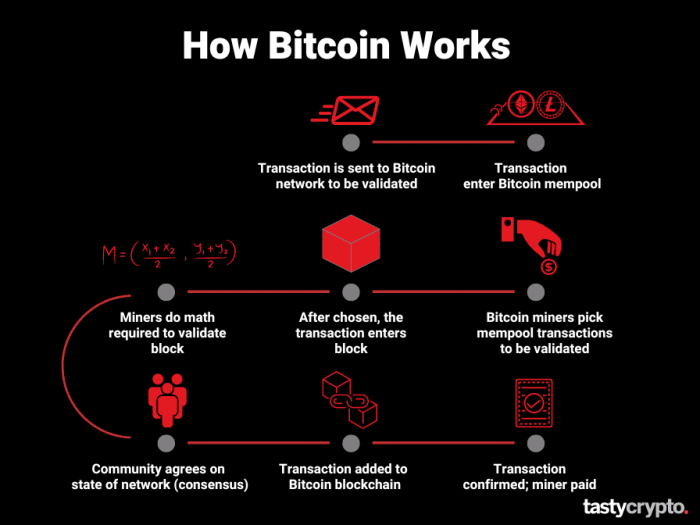
Nodes communicate with each other using a gossip protocol. When a new transaction or block is created, it’s broadcast to the network. Nodes verify the transaction or block and then relay it to their peers. This process ensures that all nodes eventually synchronize their copies of the blockchain.
Peer-to-Peer (P2P) Network Architecture
The P2P architecture is what makes Bitcoin so resilient. There’s no single point of failure. If one node goes down, the network continues to function. This decentralized structure is a key feature of Bitcoin.
Node Decentralization & Network Resilience
The more decentralized the network, the more resilient it is to attacks and censorship. If a small number of entities control a large percentage of the nodes, they could potentially collude to manipulate the blockchain. That’s why it’s important to encourage a diverse and geographically distributed network of nodes.
Transaction Pools & Confirmation Times
When you send Bitcoin, your transaction doesn’t immediately appear on the blockchain. It first enters a pool of unconfirmed transactions called the mempool. The mempool is essentially a waiting room for transactions. Miners select transactions from the mempool to include in the next block they mine.
Confirmation time refers to the amount of time it takes for a transaction to be included in a block and added to the blockchain. The more confirmations a transaction has, the more secure it is considered to be.
The Mempool & Transaction Processing
The mempool is a dynamic environment. Transactions are constantly being added and removed as miners select them for inclusion in blocks. The size of the mempool can fluctuate depending on network activity. When the mempool is congested, transactions may take longer to confirm.
Transaction Fees & Confirmation Times
Transaction fees incentivize miners to include your transaction in a block. Transactions with higher fees are typically prioritized. If you’re willing to pay a higher fee, your transaction is more likely to be confirmed quickly. Conversely, if you pay a low fee, your transaction may take longer to confirm, or even be rejected if the mempool is too full.
Block Size Limits & Transaction Throughput
Bitcoin has a block size limit, which restricts the number of transactions that can be included in each block. This limit affects transaction throughput – the number of transactions the network can process per second. Increasing the block size limit is a controversial topic, as it could potentially lead to centralization.
Factors Impacting Confirmation Times
Here’s a list of factors that can impact Bitcoin transaction confirmation times:
- Transaction Fee: Higher fees generally lead to faster confirmation times.
- Mempool Congestion: A congested mempool can cause delays.
- Block Size: The block size limit restricts transaction throughput.
- Mining Difficulty: Higher mining difficulty can slow down block creation.
- Network Hashrate: A higher network hashrate generally leads to faster block creation.
Forks: Updates & Potential Disruptions

Source: explainitdaily.com
A blockchain fork occurs when the blockchain splits into two separate chains. This can happen when there’s a disagreement about the rules of the network, or when developers want to introduce new features. Forks can be either soft forks or hard forks.
Understanding forks is crucial for understanding the evolution of Bitcoin and other cryptocurrencies. They represent moments of change and potential disruption.
Soft Fork vs. Hard Fork
Soft Fork: A soft fork is a change to the blockchain protocol that is backward-compatible. This means that nodes that haven’t upgraded to the new rules can still validate transactions on the new chain. However, they won’t be able to take advantage of the new features.
Hard Fork: A hard fork is a change to the blockchain protocol that is
-not* backward-compatible.
This means that nodes that haven’t upgraded to the new rules will not be able to validate transactions on the new chain. A hard fork creates a new cryptocurrency.
Reasons for Forks & Potential Consequences
Source: crypto-explained.com
Forks can occur for a variety of reasons, including:
- Adding New Features: Developers may want to add new features to the blockchain, such as improved privacy or scalability.
- Fixing Bugs: Forks can be used to fix bugs in the blockchain protocol.
- Resolving Disagreements: When there’s a disagreement about the direction of the project, a fork can be used to create a new chain with different rules.
The consequences of a fork can be significant. A hard fork can create a new cryptocurrency, which can dilute the value of the original cryptocurrency. It can also lead to confusion and uncertainty in the market.
Significant Bitcoin Forks in History
Some significant Bitcoin forks include:
- Bitcoin Cash (BCH): A hard fork that increased the block size limit to 8MB, aiming to improve transaction throughput.
- Bitcoin Gold (BTG): A hard fork that changed the mining algorithm to make it more resistant to ASIC mining.
- SegWit2x: A proposed hard fork that was ultimately abandoned due to lack of consensus.
The Process of a Hard Fork & New Cryptocurrency Creation
When a hard fork occurs, the blockchain splits into two separate chains. Nodes that upgrade to the new rules follow the new chain, while nodes that don’t upgrade continue to follow the old chain. Each chain has its own set of transactions and blocks. The new chain effectively becomes a new cryptocurrency, with its own market value and community.
Wallets: Managing Your Bitcoin
A Bitcoin wallet is a software program or hardware device that allows you to store, send, and receive Bitcoin. It doesn’t actually
-hold* your Bitcoin; instead, it stores the private keys that allow you to access and control your Bitcoin on the blockchain.
Choosing the right wallet is important, as it affects the security and convenience of managing your Bitcoin.
Types of Bitcoin Wallets: Hardware, Software, Online
There are several types of Bitcoin wallets:
- Hardware Wallets: These are physical devices that store your private keys offline, making them very secure. They are considered the most secure option.
- Software Wallets: These are software programs that you install on your computer or mobile device. They are less secure than hardware wallets, but more convenient.
- Online Wallets (Web Wallets): These are wallets that are hosted by a third party. They are the most convenient option, but also the least secure.
Private Key Security & Backup
Your private key is the most important part of your Bitcoin wallet. If you lose your private key, you lose access to your Bitcoin. It’s crucial to keep your private key safe and secure. Back up your private key in a secure location, and never share it with anyone.
Generating a Bitcoin Wallet Address
Generating a Bitcoin wallet address is a relatively simple process. Most wallets will automatically generate an address for you. The address is derived from your public key using a series of cryptographic transformations.
Comparison of Wallet Types
| Wallet Type | Security | Convenience | Cost |
|---|---|---|---|
| Hardware Wallet | High | Low | $50 – $200+ |
| Software Wallet | Medium | Medium | Free |
| Online Wallet | Low | High | Free |
Final Conclusion
So, there you have it – a deep dive into the world of Bitcoin and the blockchain. It’s a complex system, no doubt, but hopefully, you now have a solid grasp of the core concepts. From the distributed ledger and cryptographic security to the mining process and network of nodes, it’s a truly remarkable piece of technology.
Bitcoin isn’t just a digital currency; it’s a paradigm shift. It challenges traditional financial systems and offers a glimpse into a future where transactions are more transparent, secure, and decentralized. Whether you’re a potential investor, a tech enthusiast, or just curious about the future of money, understanding Bitcoin is becoming increasingly important. It’s a world worth exploring, and this is just the beginning.
Essential FAQs
Is Bitcoin anonymous?
Bitcoin isn’t truly anonymous, it’s
-pseudonymous*. Transactions are linked to wallet addresses, not directly to your identity. However, these addresses can sometimes be linked back to individuals through various means, like exchange accounts or IP addresses.
What happens if I lose my private key?
If you lose your private key, you lose access to your Bitcoin. There’s no central authority to recover it for you. That’s why securely backing up your private key is absolutely crucial!
How scalable is Bitcoin?
Bitcoin’s scalability is a known challenge. The block size limit and transaction processing time can lead to congestion and higher fees during peak periods. Solutions like the Lightning Network are being developed to address this.
What is the 51% attack?
A 51% attack occurs when a single entity controls more than half of the Bitcoin network’s mining power. This would theoretically allow them to manipulate transactions and potentially double-spend coins, though it’s incredibly expensive and difficult to achieve.
Are Bitcoin transactions reversible?
Generally, Bitcoin transactions are irreversible. Once a transaction is confirmed on the blockchain, it’s extremely difficult to alter or reverse it. This is a key feature of its security, but also means you need to be very careful when sending Bitcoin.