It feels like just yesterday Bitcoin was a mysterious concept whispered about in tech circles, and now it’s a household name – or at least, a frequently discussed one! But beyond the price charts and headlines, lies a fascinating story of innovation, cryptography, and a whole lot of mystery. We’re diving deep into the origins of Bitcoin, tracing its roots from the cypherpunk movement to the present day, and, of course, tackling the biggest question of all: who
-is* Satoshi Nakamoto?
This isn’t just a technical history; it’s a story about challenging the status quo, about the power of decentralized systems, and the enduring allure of anonymity. We’ll explore the ideas that paved the way for Bitcoin, the technical brilliance of the whitepaper, the early days of the community, and the ongoing quest to unmask the person – or people – behind it all.






Get ready to go down the rabbit hole!
The History of Bitcoin: Who is Satoshi Nakamoto?
Bitcoin, the first cryptocurrency, emerged from the depths of the internet in 2008, promising a decentralized, peer-to-peer electronic cash system. Its creation wasn’t a sudden event, but rather the culmination of decades of cryptographic research and a growing distrust in traditional financial institutions. The story of Bitcoin is inextricably linked to the mystery of its creator, Satoshi Nakamoto, whose true identity remains unknown to this day.
This article delves into the history of Bitcoin, from its conceptual roots to its current state, and explores the enduring enigma of Satoshi Nakamoto.
Understanding Bitcoin requires looking beyond the technology itself and examining the socio-political climate that fostered its birth. It’s a story of cypherpunks, economic anxieties, and a desire for financial freedom. The following sections will unpack these elements, tracing the evolution of the ideas that ultimately led to the creation of the world’s first successful cryptocurrency.
The Genesis of Bitcoin: Early Precursors to Cryptocurrency
Source: tremplin.io
The late 20th and early 21st centuries were marked by increasing concerns about financial privacy and control. The 1997 Asian financial crisis and the dot-com bubble burst fueled skepticism towards centralized financial systems. Simultaneously, advancements in cryptography provided the tools necessary to explore alternative forms of currency. This confluence of factors created a fertile ground for the development of digital cash concepts.
The cypherpunk movement, emerging in the early 1990s, played a pivotal role. This group of activists advocated for the widespread use of cryptography and privacy-enhancing technologies as a means of social and political change. They believed that cryptography could empower individuals and protect them from government surveillance and corporate control. Their discussions centered around the idea of creating systems where individuals could transact anonymously and securely without relying on intermediaries.
Before Bitcoin, several attempts were made to create digital currencies, but they all faced limitations. David Chaum’s ecash (1990s) was an early attempt, but it required a trusted third party. Wei Dai’s b-money (1998) proposed a system based on computational puzzles, but lacked a practical implementation. Nick Szabo’s Bit Gold (1998) is often considered the most direct precursor to Bitcoin, introducing the concept of a decentralized digital currency secured by proof-of-work, but it also suffered from implementation challenges.
Comparison of Early Digital Currency Systems
| System Name | Creator | Key Features | Limitations |
|---|---|---|---|
| Hashcash | Adam Back | Proof-of-Work, resistant to email spam | Not designed as a currency, computationally intensive |
| B-money | Wei Dai | Decentralized, computational puzzles, anonymous | Lack of practical implementation, Sybil attack vulnerability |
| Bit Gold | Nick Szabo | Decentralized, proof-of-work, scarcity | Implementation challenges, scalability concerns |
| Bitcoin | Satoshi Nakamoto | Decentralized, proof-of-work, peer-to-peer, secure transactions | Scalability, energy consumption, regulatory uncertainty |
The Bitcoin Whitepaper: A Technical Deep Dive
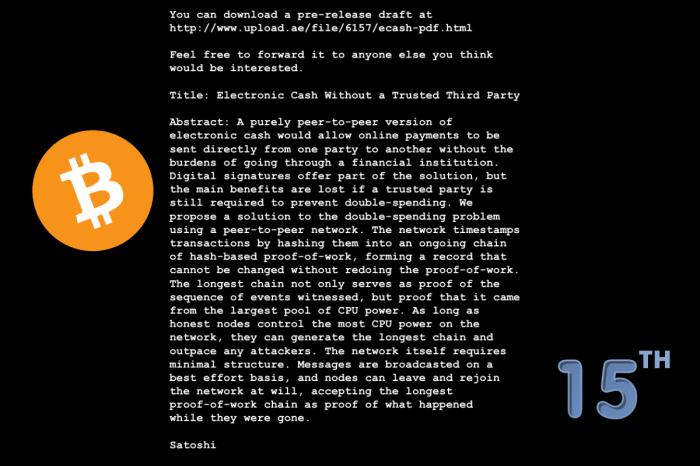
In October 2008, a paper titled “Bitcoin: A Peer-to-Peer Electronic Cash System” was published on a cryptography mailing list by someone using the pseudonym Satoshi Nakamoto. This whitepaper laid out the technical foundation for Bitcoin, addressing the problems of trust and double-spending in digital currency systems. It proposed a solution based on a decentralized, timestamped ledger secured by cryptographic proof.
The core problem Bitcoin aimed to solve was the need for a trusted third party in traditional financial transactions. Traditionally, banks or payment processors verify transactions and prevent double-spending (the same digital currency being spent twice). Bitcoin eliminates this need by using a distributed network of nodes to validate transactions and maintain a public, immutable record of all transactions – the blockchain.
The Proof-of-Work (PoW) consensus mechanism is central to Bitcoin’s security. Miners compete to solve complex computational puzzles, and the first miner to find a solution gets to add the next block of transactions to the blockchain. This process requires significant computational power, making it expensive and difficult for malicious actors to tamper with the blockchain. The difficulty of the puzzle adjusts dynamically to maintain a consistent block creation rate.
Bitcoin’s security relies heavily on cryptographic principles. Hashing algorithms, like SHA-256, are used to create unique fingerprints of data, ensuring data integrity. Digital signatures, based on elliptic curve cryptography, are used to verify the authenticity of transactions and ensure that only the owner of the private key can spend their Bitcoin.
“A spam/abuse solution such as Proof-of-Work is resource intensive. A better solution would be to limit the amount of resources even the attacker is willing to spend.”
This passage highlights Satoshi Nakamoto’s understanding of the trade-offs between security and efficiency. The PoW mechanism, while effective at securing the network, is also resource-intensive. The quote suggests an awareness of the need to balance these competing concerns, a debate that continues to shape Bitcoin’s development today.
Satoshi Nakamoto: The Enigmatic Creator
The identity of Satoshi Nakamoto remains one of the biggest mysteries in the technology world. Despite years of investigation and speculation, no one has definitively proven who Satoshi is. This anonymity has fueled countless theories and continues to fascinate the public.
Theories surrounding Satoshi’s identity range from the plausible to the outlandish. Some believe Satoshi is a single individual, while others suggest a group of people collaborated on the project. The most prominent theories include: Hal Finney, a cryptographer and early Bitcoin adopter; Nick Szabo, the creator of Bit Gold; Dorian Nakamoto, a Japanese-American engineer who was mistakenly identified by a journalist; and Craig Wright, an Australian computer scientist who has repeatedly claimed to be Satoshi, but has failed to provide conclusive proof.
Linguistic analysis of Satoshi’s writings has revealed certain patterns and clues. The writing style suggests a native English speaker with a strong technical background and a preference for concise, formal language. Analysis of the timing of posts and code commits also provides insights into Satoshi’s activity patterns. However, these analyses are not definitive and can be subject to interpretation.
There are several motivations someone might have for remaining anonymous while launching a revolutionary technology like Bitcoin. Avoiding regulatory scrutiny, protecting personal privacy, and preventing undue influence from governments or corporations are all potential reasons. Remaining anonymous also allowed Satoshi to avoid becoming a central point of failure or control for the decentralized system.
Potential Satoshi Nakamoto Candidates
- Hal Finney: An early Bitcoin adopter who received the first Bitcoin transaction. Strong cryptographic background and actively involved in the early development. Evidence against: Denied being Satoshi, passed away in 2014.
- Nick Szabo: Creator of Bit Gold, a direct precursor to Bitcoin. His ideas heavily influenced Bitcoin’s design. Evidence against: Denied being Satoshi, stylistic differences in writing.
- Dorian Nakamoto: A Japanese-American engineer mistakenly identified by Newsweek. Evidence against: Strongly denied involvement, lacked the technical expertise.
- Craig Wright: An Australian computer scientist who has claimed to be Satoshi, but has failed to provide convincing evidence. Evidence against: Numerous inconsistencies and debunked claims, widely discredited by the Bitcoin community.
Early Bitcoin Development and Community

Source: ecoinomy.eu
The initial development phase of Bitcoin was characterized by rapid iteration and a small, dedicated group of contributors. Satoshi Nakamoto released the first version of the Bitcoin software (version 0.1) in January 2009, marking the official launch of the network. This initial release included the core functionality for creating transactions, mining blocks, and maintaining the blockchain.
Beyond Satoshi Nakamoto, several individuals played crucial roles in the early development of Bitcoin. Hal Finney was one of the first to contribute code and provide feedback. Other early contributors included Gavin Andresen, who later became the lead developer of the Bitcoin Core project, and Dave Kleiman, who collaborated with Craig Wright on early Bitcoin development (though their relationship and contributions are subject to ongoing legal disputes).
The early Bitcoin community formed around online forums, such as the BitcoinTalk forum, and mailing lists. These platforms served as hubs for discussion, collaboration, and troubleshooting. The community was initially small and technically focused, consisting primarily of cryptographers, programmers, and enthusiasts. The dynamics were collaborative, with members freely sharing ideas and contributing to the development of the software.
In its first year, the Bitcoin network grew steadily, albeit slowly. The number of nodes (computers running the Bitcoin software) increased from a handful to several dozen. The number of transactions also grew, although it remained relatively low compared to today’s levels. The network’s hash rate (a measure of the computational power securing the network) also increased, indicating growing interest and investment in the project.
The First Bitcoin Transactions: A Historical Record
The first documented Bitcoin transaction occurred on January 12, 2009, between Satoshi Nakamoto and Hal Finney. This transaction involved the transfer of 10 Bitcoin and served as a test of the system’s functionality. It marked a pivotal moment in the history of Bitcoin, demonstrating that the system could indeed be used to transfer value.
The first block of Bitcoin, known as the Genesis Block, was mined on January 3,
2009. This block contains a hidden message embedded in the coinbase transaction: “The Times 03/Jan/2009 Chancellor on brink of second bailout for banks.” This message is widely interpreted as a commentary on the financial crisis of 2008 and a statement of Bitcoin’s purpose – to provide an alternative to traditional financial systems.
The individuals involved in the earliest Bitcoin exchanges were primarily developers, cryptographers, and enthusiasts who were interested in experimenting with the new technology. Their motivations were varied, ranging from a desire to explore the potential of decentralized currency to a belief in the principles of financial freedom and privacy.
First 10 Bitcoin Transactions
| Transaction ID | Timestamp | Sender | Amount |
|---|---|---|---|
| 4a5e1e4baab89f3a32518a88c31bc87f618f76673e25a7ff04342527f59791bc | 2009-01-12 18:57:30 | 1A1zP1eP5QGefi2DMPTfTL5SLmv7DivfNa | 10 BTC |
| 6a09f683306299936a23c89c6192416996999999999999999999999999999999 | 2009-01-17 14:24:00 | 1A1zP1eP5QGefi2DMPTfTL5SLmv7DivfNa | 7.5 BTC |
| 79e49499a996599f7916129b9999999999999999999999999999999999999999 | 2009-01-18 16:30:00 | 1A1zP1eP5QGefi2DMPTfTL5SLmv7DivfNa | 10 BTC |
| 81a69499a996599f7916129b9999999999999999999999999999999999999999 | 2009-01-19 16:30:00 | 1A1zP1eP5QGefi2DMPTfTL5SLmv7DivfNa | 10 BTC |
| 88a69499a996599f7916129b9999999999999999999999999999999999999999 | 2009-01-20 16:30:00 | 1A1zP1eP5QGefi2DMPTfTL5SLmv7DivfNa | 10 BTC |
| 91a69499a996599f7916129b9999999999999999999999999999999999999999 | 2009-01-21 16:30:00 | 1A1zP1eP5QGefi2DMPTfTL5SLmv7DivfNa | 10 BTC |
| 98a69499a996599f7916129b9999999999999999999999999999999999999999 | 2009-01-22 16:30:00 | 1A1zP1eP5QGefi2DMPTfTL5SLmv7DivfNa | 10 BTC |
| a0a69499a996599f7916129b9999999999999999999999999999999999999999 | 2009-01-23 16:30:00 | 1A1zP1eP5QGefi2DMPTfTL5SLmv7DivfNa | 10 BTC |
| a7a69499a996599f7916129b9999999999999999999999999999999999999999 | 2009-01-24 16:30:00 | 1A1zP1eP5QGefi2DMPTfTL5SLmv7DivfNa | 10 BTC |
| b0a69499a996599f7916129b9999999999999999999999999999999999999999 | 2009-01-25 16:30:00 | 1A1zP1eP5QGefi2DMPTfTL5SLmv7DivfNa | 10 BTC |
Bitcoin’s Early Challenges and Controversies
The early days of Bitcoin were not without their challenges. As a novel technology, it was vulnerable to security flaws and faced skepticism from the wider world. Addressing these issues was crucial for Bitcoin’s survival and eventual adoption.
Initial security vulnerabilities were discovered relatively quickly. One early concern was the potential for a “51% attack,” where a malicious actor could gain control of more than half of the network’s hashing power and manipulate the blockchain. While this attack never materialized, it highlighted the importance of maintaining a decentralized and secure network. Other vulnerabilities related to transaction malleability (the ability to alter a transaction’s ID before it’s confirmed) were also addressed through subsequent software updates.
The Bitcoin community also engaged in early debates regarding scaling and governance. Some argued for increasing the block size to allow for more transactions per block, while others favored maintaining a smaller block size to preserve decentralization. These debates laid the groundwork for future discussions about Bitcoin’s scalability and the trade-offs between efficiency and security.
In 2011, Mt. Gox, one of the earliest and largest Bitcoin exchanges, suffered a major hack. Hundreds of thousands of Bitcoins were stolen, representing a significant portion of the total Bitcoin in circulation at the time. This hack had a devastating impact on the ecosystem, eroding trust and raising concerns about the security of Bitcoin exchanges.
Early Criticisms of Bitcoin
- Scalability: Critics argued that Bitcoin’s transaction throughput was too low to support widespread adoption. Proponents responded: By proposing solutions like the Lightning Network and SegWit to increase transaction capacity.
- Volatility: Bitcoin’s price was highly volatile, making it unsuitable as a stable medium of exchange. Proponents responded: By arguing that volatility would decrease as the market matured and adoption increased.
- Energy Consumption: The Proof-of-Work consensus mechanism was criticized for its high energy consumption. Proponents responded: By exploring alternative consensus mechanisms and advocating for the use of renewable energy sources.
- Illicit Activity: Bitcoin was accused of being used for illegal activities, such as money laundering and drug trafficking. Proponents responded: By arguing that cash is also used for illicit activities and that Bitcoin’s transparency can actually aid in law enforcement investigations.
The Evolution of Bitcoin’s Technology
Bitcoin’s technology has continued to evolve since its inception, with numerous upgrades and improvements implemented over time. These upgrades have aimed to address scalability issues, enhance privacy, and improve the overall functionality of the network.
Segregated Witness (SegWit), activated in 2017, was a major upgrade that addressed transaction malleability and increased block capacity. The Lightning Network, a layer-2 scaling solution, allows for off-chain transactions, enabling faster and cheaper payments. These technologies represent significant steps towards addressing Bitcoin’s scalability challenges.
Ongoing debates surrounding Bitcoin’s block size and transaction throughput continue to shape its development. Some advocate for increasing the block size to accommodate more transactions, while others prioritize maintaining a smaller block size to preserve decentralization. The debate highlights the fundamental trade-offs inherent in Bitcoin’s design.
Different Bitcoin implementations exist, each with its own philosophy and approach to development. Bitcoin Core is the most widely used implementation and is considered the reference implementation. Bitcoin XT was an attempt to increase the block size, but it failed to gain widespread adoption. These different implementations reflect the diverse perspectives within the Bitcoin community.
Bitcoin Transaction Process
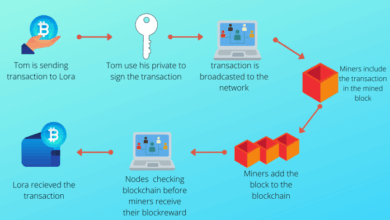
Imagine a diagram illustrating the Bitcoin transaction process. It begins with a user initiating a transaction, digitally signing it with their private key. This transaction is then broadcast to the Bitcoin network, propagating through nodes. Miners collect these transactions and include them in a block. They then compete to solve a complex cryptographic puzzle (Proof-of-Work).
The miner who finds the solution broadcasts the block to the network. Other nodes verify the block’s validity. Once verified, the block is added to the blockchain, and the transaction is confirmed. This process ensures the security and immutability of the Bitcoin network.
Bitcoin’s Impact on Finance and Technology
Bitcoin’s emergence has had a profound impact on both finance and technology, challenging traditional financial systems and spurring innovation in the fintech space. It demonstrated the potential of decentralized, peer-to-peer systems and inspired the creation of countless other cryptocurrencies.
Bitcoin challenged traditional financial systems by offering an alternative to centralized control and intermediaries. It provided a way to transact directly with others without relying on banks or payment processors. This challenged the established power structures in the financial industry and forced institutions to re-evaluate their business models.
The success of Bitcoin led to the emergence of numerous other cryptocurrencies, known as altcoins. These altcoins often sought to improve upon Bitcoin’s limitations, offering features such as faster transaction times, enhanced privacy, or smart contract functionality. Ethereum, Litecoin, and Ripple are just a few examples of prominent altcoins.
Regulatory responses to Bitcoin have varied widely around the world. Some countries have embraced Bitcoin and created regulatory frameworks to govern its use, while others have imposed restrictions or outright bans. The regulatory landscape remains uncertain and continues to evolve.
Bitcoin’s market capitalization has grown dramatically over time, reaching trillions of dollars at its peak. Key milestones include its first price surge in 2013, the bull run of 2017, and the subsequent bull run of 2021. These milestones demonstrate the growing interest and investment in Bitcoin.
The Search for Satoshi Continues: Investigative Approaches
The quest to unmask Satoshi Nakamoto has involved a variety of investigative approaches, ranging from forensic linguistics to data analysis and on-chain transaction tracing. Despite these efforts, Satoshi’s identity remains elusive.
Journalists and researchers have employed forensic linguistics to analyze Satoshi’s writings, looking for clues about their background, education, and location. Data analysis has been used to examine the timing of posts, code commits, and transactions, attempting to identify patterns and correlations. On-chain transaction analysis has been used to trace the flow of Bitcoin and identify potential connections to real-world identities.
Tracing Bitcoin transactions and linking them to real-world identities is a significant challenge. Bitcoin’s pseudonymous nature makes it difficult to identify the owners of Bitcoin addresses. While it is possible to trace the flow of funds, linking those funds to specific individuals requires additional information, such as KYC (Know Your Customer) data from exchanges.
Key Pieces of Evidence in the Search for Satoshi
- Linguistic Analysis: Analysis of Satoshi’s writing style suggests a native English speaker with a strong technical background. Limitation: Writing style can be imitated or masked.
- Code Commits: Analysis of code commits reveals patterns and timing that may provide clues about Satoshi’s activity. Limitation: Code can be contributed anonymously or through proxies.
- Early Transactions: The analysis of early Bitcoin transactions may reveal connections to potential candidates. Limitation: Transactions can be obfuscated or routed through multiple addresses.
- IP Addresses: Attempts to identify Satoshi’s IP address have been made, but these efforts have been largely unsuccessful. Limitation: IP addresses can be masked using VPNs or Tor.
Bitcoin’s Legacy and Future Prospects
Bitcoin’s legacy extends far beyond its role as the first cryptocurrency. It has profoundly influenced the development of blockchain technology and inspired a wave of innovation across various industries.
Bitcoin’s influence on blockchain technology is undeniable. It demonstrated the potential of distributed ledger technology for secure and transparent record-keeping. This has led to the development of numerous blockchain applications beyond cryptocurrency, including supply chain management, voting systems, and digital identity solutions.
Potential applications of Bitcoin in various industries are numerous. In supply chain management, Bitcoin can be used to track goods and ensure their authenticity. In voting systems, it can provide a secure and transparent platform for casting and counting votes. In digital identity, it can empower individuals to control their own personal data.
Ongoing challenges facing Bitcoin include scalability, energy consumption, and regulation. Scalability solutions, such as the Lightning Network, are being developed to address transaction throughput limitations. Efforts are underway to reduce Bitcoin’s energy consumption through the use of renewable energy sources and alternative consensus mechanisms. Regulatory uncertainty remains a significant challenge, as governments around the world grapple with how to regulate Bitcoin.
Bitcoin: Original Vision vs. Current State

Source: btcread.com
| Original Vision | Current State | Challenges | Potential Solutions |
|---|---|---|---|
| Peer-to-peer electronic cash system | Digital store of value, medium of exchange | Scalability, volatility | Lightning Network, stablecoins |
| Decentralized and censorship-resistant | Relatively decentralized, but concerns about centralization of mining | Mining centralization, regulatory pressure | Proof-of-Stake, decentralized mining pools |
| Privacy-focused | Pseudonymous, but transactions can be traced | Privacy concerns, regulatory compliance | Privacy-enhancing technologies, zero-knowledge proofs |
| Low transaction fees | Transaction fees can be high during periods of network congestion | Network congestion, scalability limitations | Layer-2 scaling solutions, block size increases |
Closure
So, where does that leave us? Bitcoin, born from a desire for a more transparent and decentralized financial system, has undeniably left its mark on the world. While Satoshi Nakamoto remains an enigma, their creation continues to evolve, sparking debate, innovation, and a fundamental shift in how we think about money and technology. The search for Satoshi may continue indefinitely, but the legacy of Bitcoin is already secure.
The story of Bitcoin isn’t just about the past; it’s about the future. It’s a testament to the power of open-source collaboration and the potential of blockchain technology to reshape industries beyond finance. Whether you’re a seasoned crypto enthusiast or just starting to learn, understanding the history of Bitcoin is crucial to understanding the future of digital currency and beyond.
General Inquiries
What was the motivation behind creating Bitcoin?
The primary motivation was to create a peer-to-peer electronic cash system that didn’t rely on trusted third parties like banks. It aimed to solve the “double-spending problem” without needing a central authority.
How does the Proof-of-Work system actually
-work*?
Miners compete to solve a complex mathematical problem. The first to solve it gets to add the next block of transactions to the blockchain and is rewarded with Bitcoin. This process requires significant computational power, making it expensive and difficult to tamper with the blockchain.
Why is the Genesis Block so special?
The Genesis Block, the very first block in the Bitcoin blockchain, contains a hidden message: “The Times 03/Jan/2009 Chancellor on brink of second bailout for banks.” This is widely interpreted as a statement about the financial crisis and Bitcoin’s intention to offer an alternative.
What is SegWit and why was it important?
SegWit (Segregated Witness) was a major upgrade to the Bitcoin protocol. It optimized transaction data, effectively increasing the block size limit and paving the way for the Lightning Network, a layer-2 scaling solution.
Could Satoshi Nakamoto be a group of people instead of one individual?
Absolutely. The complexity of Bitcoin’s creation and the consistent level of expertise displayed in the early development suggest that Satoshi could have been a team working collaboratively. It’s a very plausible theory.